Interlobar surface (Latin: facies interlobaris)
The interlobar surfaces are the surfaces where the lobes of the lung meet one another (right lung: superior and middle, superior and inferior, middle and inferior lobes; left lung: superior and inferior lobes).
The lobes are separated by the fissures (horizontal fissure and oblique fissure): three lobes on the right and two on the left
 Lobes and interlobar surfaces
 Both lungs (anterior view)
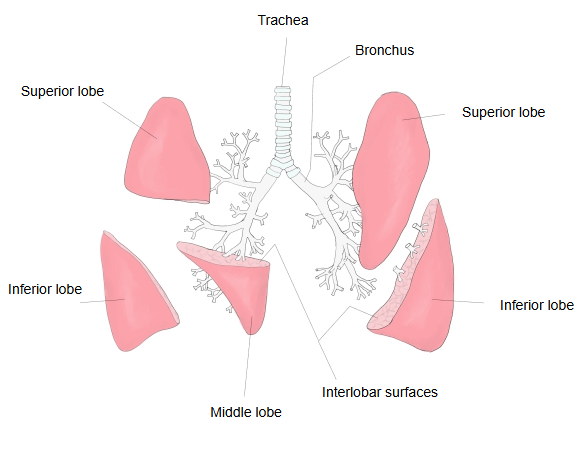
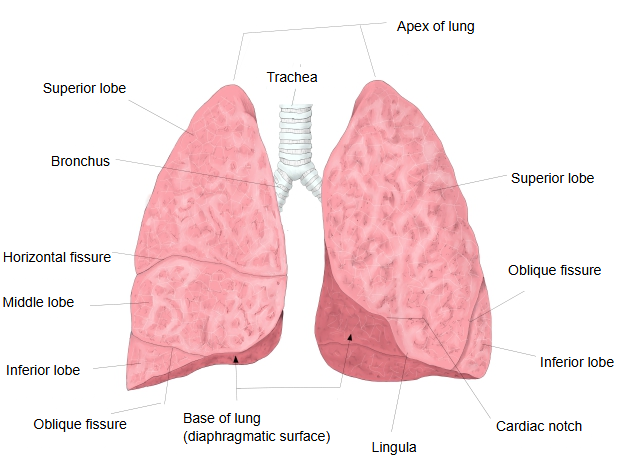
The pulmonary pleura covering the lung dips into the oblique fissure and the horizontal fissure and separates the lobes almost completely, so that they are joined mainly by the bronchi and vessels at the hilum. The faces of neighbouring lobes in contact with each other are the interlobar surfaces. Fissures are often incomplete, and then the lobes are partly fused.
Related terms
- Lobe of lung
- Oblique fissure
- Horizontal fissure
- Superior lobe
- Middle lobe
- Inferior lobe
- Pulmonary pleura
References and sources
- Further reading: Lobes of lung, Wikipedia.
- Federative International Programme for Anatomical Terminology (FIPAT). Terminologia Anatomica, 2nd ed. (TA2), 2019.