Interprismatic substance (Latin: substantia interprismatica)
Also called the interrod enamel or the interprismatic enamel
of enamel
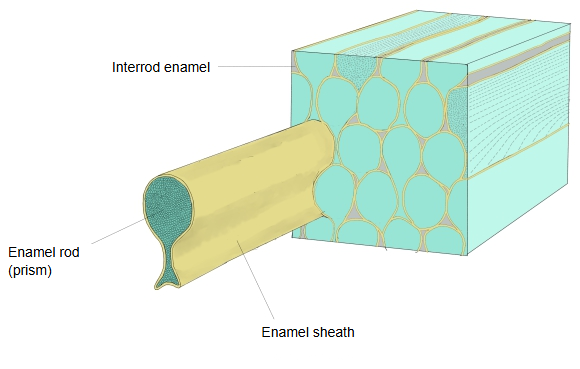
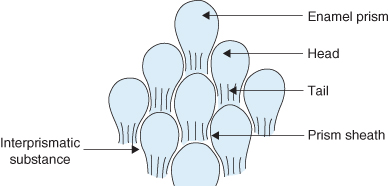
- Enamel rod : the main element of enamel: a bundle of hydroxyapatite crystals that runs closely packed, without branching, from the dentinoenamel junction to the surface of the crown
- Enamel sheath : the thin boundary layer around each rod, less mineralized and richer in organic matter
- Interprismatic substance : hydroxyapatite crystals that fill the narrow spaces between the rods (interrod enamel)
Its crystals are the same as those of the rods, but they run in a different direction, so the border of each rod shows up. Together with the rods and the enamel sheaths around them, it makes up the enamel that covers the crown of a tooth. Rods and interrod enamel are laid down by the same enamel-forming cells, the ameloblasts.
In human enamel, where the rods are keyhole-shaped in cross-section, much of the interrod enamel is continuous with the tails of the rods. Sources differ on where the border between rod and interrod enamel is drawn.
Reference websites
[Wikipedia]
· Tooth enamel, Wikipedia.
[Websites with illustrations]
· Enamel rods and interrod enamel (Pocket Dentistry)
· Section of enamel (ostia-antica.org)

· Rod and interrod enamel (figure) (Elsevier (Acta Biomaterialia))

Related terms
References and sources
- Further reading: Tooth enamel, Wikipedia.
- Federative International Programme for Anatomical Terminology (FIPAT). Terminologia Anatomica, 2nd ed. (TA2), 2019.