Iridial part of retina (Latin: Pars iridica retinae)
Also called the iris part of retina
of the
retina
- Optic part of the retina : the part that senses light; made of nerve cells and connective (supporting) tissue, in which 10 layers can be distinguished. Its front border is the ora serrata.
- Blind part of the retina : does not sense light; begins in front of the ora serrata.
- Ciliary part of the retina : covers the inner surface of the ciliary body; two layers of epithelial cells, the outer one pigmented, the inner one without pigment.
- Iridial part of the retina : covers the back of the iris; two layers of epithelial cells, both heavily pigmented (the front layer is the pigmented layer of the iris).
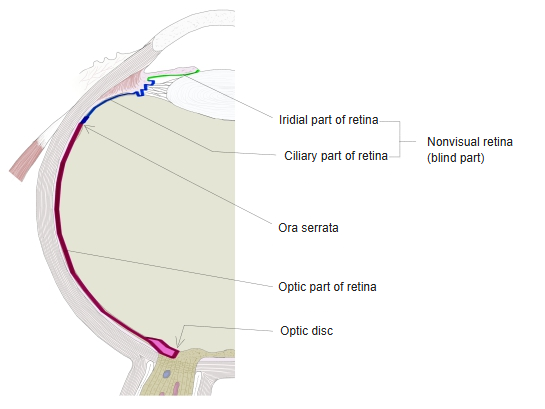
The iridial part continues forwards from the ciliary part of the retina and reaches the edge of the pupil. It is the two-layered posterior pigment epithelium on the back (inner) surface of the iris, just as two epithelial layers line the ciliary body. The front layer is the pigmented layer of the iris. The back layer of epithelial cells lies directly on it, and the two layers are continuous with each other at the edge of the pupil. The back layer is about 30-35 µm thick in one classic description. Its cells hold so much pigment that their nuclei are hidden and their borders can hardly be seen; in bleached sections, or in albinos, the cell borders are easy to make out. This dark layer stops light passing through the iris except at the pupil. It does not sense light.
Related terms
- Optic part of retina
- Ciliary part of retina
- Non-visual retina
- Retina
- Iris
- Posterior limiting lamina of iris
- Ora serrata
- Ciliary body
- Inner layer of eyeball
References and sources
- Further reading: Iris (anatomy), Wikipedia.
- Further reading: Retina, Wikipedia.
- Federative International Programme for Anatomical Terminology (FIPAT). Terminologia Anatomica, 2nd ed. (TA2), 2019.