Ciliary part of retina (Latin: Pars ciliaris retinae)
The ciliary part of the retina is one part of the blind part of the retina: the part that lines the inner surface of the ciliary body.
Retina: the innermost layer of the wall of the eyeball (inner layer of the eyeball)Blind part: the part of the retina that does not sense light
The ciliary part of the retina is a two-layered epithelium: the outer layer is pigmented, and the inner layer is a single layer of epithelial cells without pigment that contains fine granules.
Parts
of the
retina
of the
retina
- Optic part of the retina : the part that senses light; made of nerve cells and connective (supporting) tissue, in which 10 layers can be distinguished. Its front border is the ora serrata.
- Blind part of the retina : does not sense light; begins in front of the ora serrata.
- Ciliary part of the retina : covers the inner surface of the ciliary body; two layers of epithelial cells, the outer one pigmented, the inner one without pigment.
- Iridial part of the retina : covers the back of the iris; two layers of epithelial cells, both heavily pigmented.
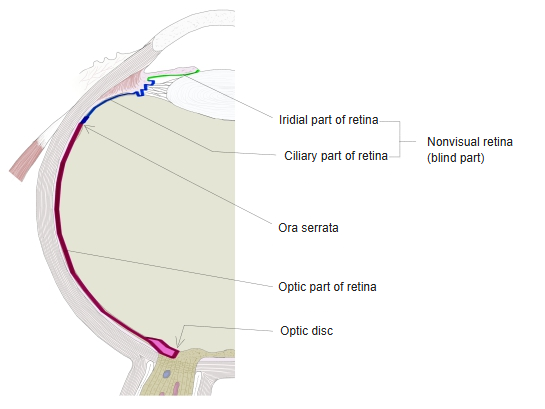
The ciliary part begins at the ora serrata, where the multilayered optic part of the retina ends, and continues forwards into the iridial part. Its inner layer is only a single layer of epithelial cells; they have no pigment, contain fine granules and look finely striated lengthwise. The cells are low over the large ciliary processes (about 14 µm in one classic description) and become markedly taller towards the ora serrata (about 40-50 µm). This epithelium makes the aqueous humour and anchors the fibres of the ciliary zonule; it does not sense light.
Related terms
- Optic part of retina
- Iridial part of retina
- Non-visual retina
- Retina
- Ciliary body
- Ora serrata
- Iris
- Inner layer of eyeball
- Radial fibers of ciliary muscle
References and sources
- Further reading: Ciliary body, Wikipedia.
- Further reading: Retina, Wikipedia.
- Federative International Programme for Anatomical Terminology (FIPAT). Terminologia Anatomica, 2nd ed. (TA2), 2019.