Lamina of modiolus (Latin: lamina modioli)
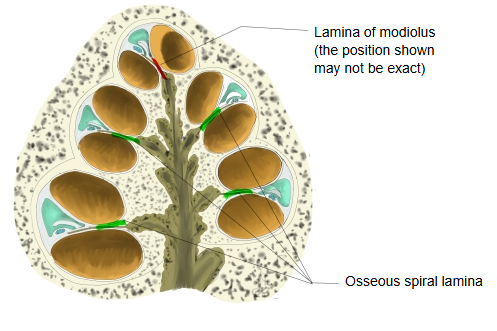
At the start of the last half turn, the osseous spiral lamina leaves the modiolus and projects freely into the cochlear canal as a sickle-shaped bony plate. This free part is called the hamulus of the spiral lamina; its convex edge faces outwards and its concave edge faces the lamina of modiolus (the continuation of the modiolus). The opening bounded by the hamulus is the helicotrema. The membranous spiral lamina arises from the convex edge of the hamulus, and the cochlear duct is attached to it; neither of them fills the helicotrema. Through this opening the scala vestibuli and the scala tympani are continuous with each other; everywhere else the two scalae are completely separated, and they communicate freely only through the helicotrema.
Near the apex of the cochlea the modiolus thins out into this narrow plate, the end of the modiolus, where it joins the hamulus of the spiral lamina. Sources differ in how they describe its exact extent.
Related terms
References and sources
- Further reading: Modiolus (cochlea), Wikipedia.
- Further reading: Helicotrema, Wikipedia.
- Federative International Programme for Anatomical Terminology (FIPAT). Terminologia Anatomica, 2nd ed. (TA2), 2019.