Spiral canal of cochlea (Latin: canalis spiralis cochleae)
Also called the cochlear canal
· At its start the canal is about 3 mm across; it narrows gradually towards the apex.
· The basilar membrane, which stretches from the free edge of the osseous spiral lamina to the outer wall, completes this division into upper and lower levels.
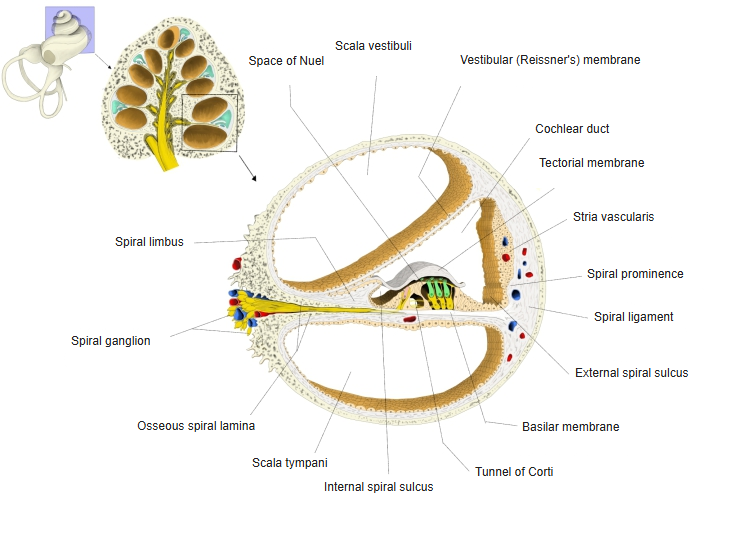
· The scala vestibuli and scala tympani are filled with perilymph, and the cochlear duct with endolymph.
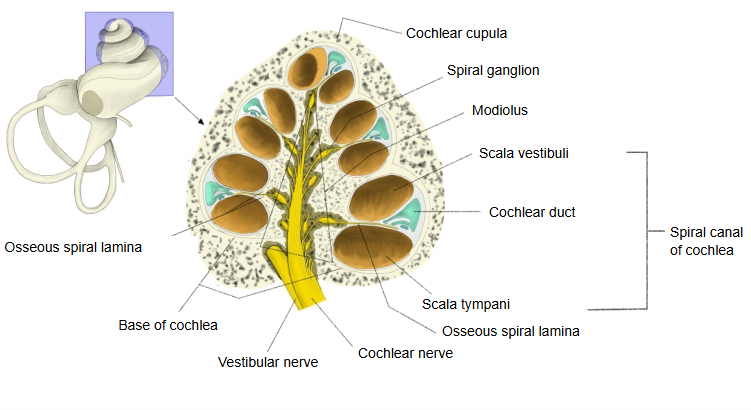
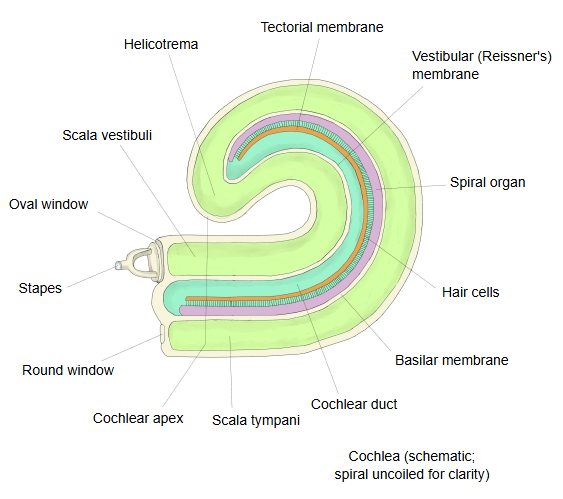
- Scala vestibuli : upper level of the spiral canal; filled with perilymph; passes the sound vibration on to the cochlear duct; part of the bony labyrinth.
- Vestibular membrane : (Reissner's membrane) separates the scala vestibuli from the cochlear duct.
- Cochlear duct : also in the upper level; filled with endolymph and holds the spiral organ; both ends are blind. Contents: the tectorial membrane, the organ of Corti, the internal and external spiral sulci, the spiral prominence and the stria vascularis.
- Osseous spiral lamina + basilar membrane : (with the secondary spiral lamina) separate the upper level from the lower level.
- Scala tympani : lower level of the spiral canal; part of the bony labyrinth, filled with perilymph; carries the travelling wave to the round window. It joins the scala vestibuli at the helicotrema.
- Modiolus : the cone of spongy bone at the centre of the cochlea, with the longitudinal canals and the spiral canal of the modiolus.
Turns
| First turn (= basal turn) | The lowest turn, which forms the base of the cochlea; it is the widest. |
| Third turn (= apical turn) | The smallest turn; it narrows gradually and ends blindly at the cochlear cupula. |
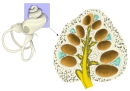 Spiral canal of the cochlea (cross-section)
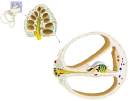 Spiral canal of the cochlea (cross-section, enlarged)
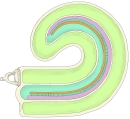 Spiral canal of the cochlea (model)
In short:
The spiral canal of the cochlea is a bony tube that winds in a spiral around the modiolus, from the base of the cochlea to the cochlear cupula. A shelf-like process that projects almost horizontally from the modiolus into the lumen is the osseous spiral lamina; it divides the canal incompletely into an upper level, the scala vestibuli, and a lower level, the scala tympani.
The two scalae communicate at the apex through the helicotrema. At its base the canal opens into the vestibule, faces the tympanic cavity at the round window (closed by the secondary tympanic membrane), and connects with the cochlear canaliculus. Not to be confused with the spiral canal of the modiolus, the small canal inside the modiolus that holds the spiral ganglion.
Reference websites
[Wikipedia]
· Cochlea, Wikipedia.
[Websites with illustrations]
· Cochlea (figure) (David Darling)

· Anatomy of the cochlear duct (figure) (Focused Collection)

· Section through the cochlea (figure) (Veterian Key)

Related terms
References and sources
- Further reading: Cochlea, Wikipedia.
- Federative International Programme for Anatomical Terminology (FIPAT). Terminologia Anatomica, 2nd ed. (TA2), 2019.