Scala vestibuli
Also called Vestibular duct
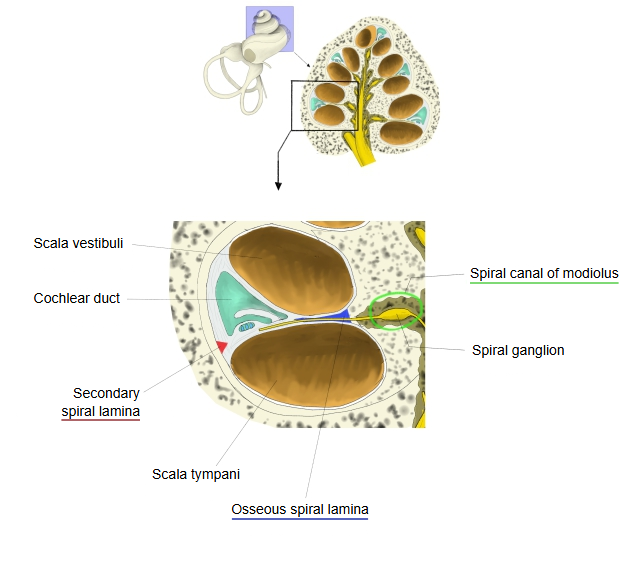
The scala vestibuli is one of the parts of the spiral canal of the cochlea, which makes up the cochlea: the channel that lies above the cochlear duct.
Cochlea: one of the parts of the internal ear (organ of hearing)The canal that winds in a spiral through the outer part of the cochlea= above the osseous spiral lamina and the vestibular (Reissner's) membrane
- Spiral canal of the cochlea : total length about 3 cm, about 2.5–2.75 turns.
- Upper level
- Scala vestibuli : filled with perilymph; carries the sound vibrations to the cochlear duct; part of the bony labyrinth. Joined to the scala tympani at the apex through the helicotrema.
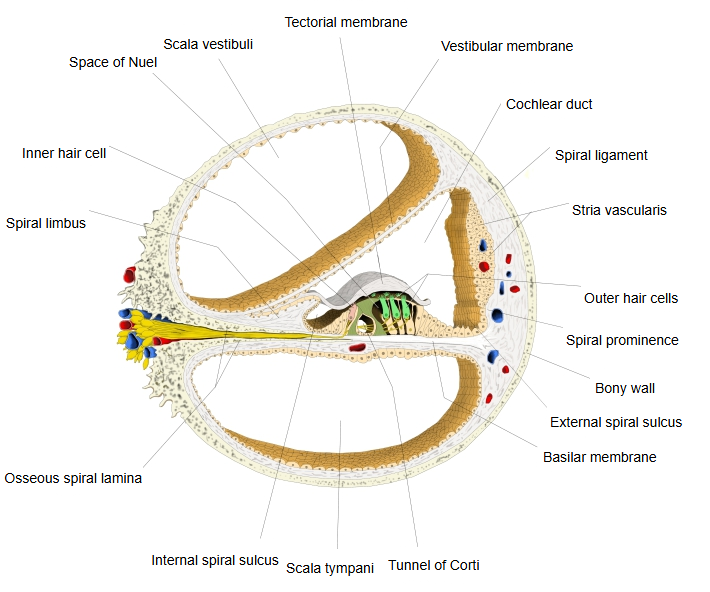
- Cochlear duct : separated from the scala vestibuli by the vestibular (Reissner's) membrane; filled with endolymph and contains the spiral organ (organ of Corti); both ends are blind. Contents: tectorial membrane, organ of Corti, internal and external spiral sulci, spiral prominence, stria vascularis.
- Lower level
- Scala tympani : part of the bony labyrinth, filled with perilymph; passes the travelling wave on to the tympanic cavity. Its boundary with the upper level: the osseous spiral lamina + the basilar membrane (+ the secondary spiral lamina).
- Upper level
- Modiolus : the cone of spongy bone at the centre of the cochlea, with the longitudinal canals and the spiral canal of the modiolus.
Like the scala tympani, the scala vestibuli is part of the bony labyrinth and is filled with perilymph.
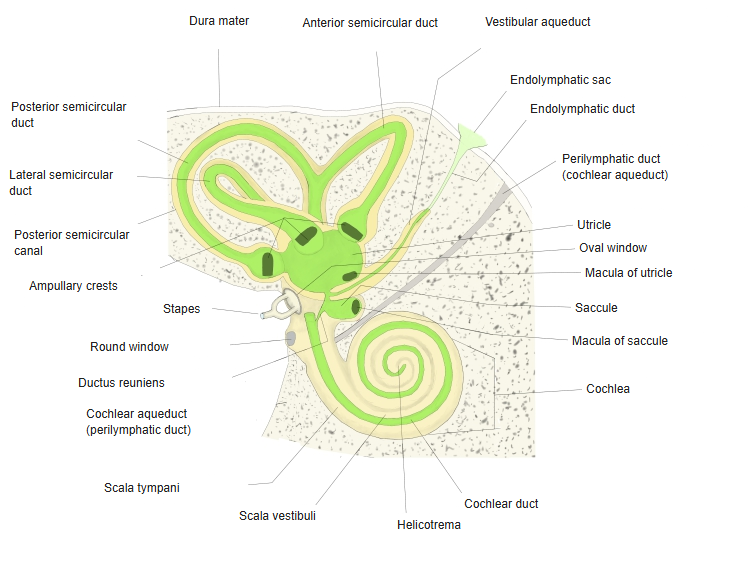
The internal ear is made of the outer bony labyrinth and the membranous labyrinth inside itPerilymph fills the space between the bony and the membranous labyrinth (the perilymphatic space)
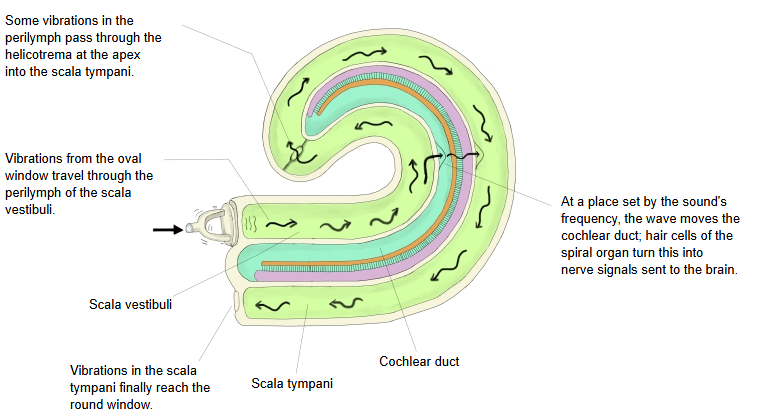
The scala vestibuli is completely separated from the cochlear duct, but it is joined to the scala tympani through the helicotrema.
by the vestibular (Reissner's) membraneat the apex of the cochlea (cochlear cupula)
Function: the scala vestibuli carries the sound vibrations (the travelling wave) through the vestibular membrane to the cochlear duct, and through the perilymph to the scala tympani.
In the cochlear duct the hair cells of the organ of Corti turn them into electrical signalsThey are finally released to the tympanic cavity through the round window
· The scala vestibuli runs spirally around the modiolus. It begins at the vestibule, next to the oval window, where the footplate of the stapes passes sound vibrations into its perilymph.
· The vibrations move the cochlear duct and the basilar membrane, where the hair cells of the spiral organ turn them into nerve signals; the pressure wave is released through the scala tympani at the round window.
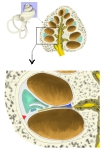 One turn of the cochlea
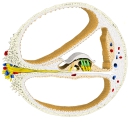 Cochlear duct (cross-section)
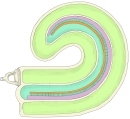 Path of sound in the cochlea
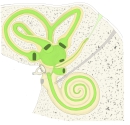 Bony and membranous labyrinths
Reference websites
[Wikipedia]
· Vestibular duct, Wikipedia.
[Websites with illustrations]
· The inner ear (TeachMeAnatomy)
· Anatomy of the internal ear (Blausen) (Wikimedia Commons)

· Longitudinal section of the cochlea (Gray's Anatomy, fig. 928) (Wikimedia Commons)

Related terms
- Vestibular aqueduct
- External aperture of vestibular aqueduct
- Internal aperture of vestibular aqueduct
- Vestibular ganglion
- Pyramid of vestibule
- Vestibular crest
- Cochlea
- Cochlear duct
- Scala tympani
- Helicotrema
- Oval window
- Perilymphatic space
- Modiolus
References and sources
- Further reading: Vestibular duct, Wikipedia.
- Federative International Programme for Anatomical Terminology (FIPAT). Terminologia Anatomica, 2nd ed. (TA2), 2019.