Line (bone) (Latin: linea)
A line of a bone is a long, narrow, slightly raised mark on the surface of a bone.
It often marks the attachment of a muscle, ligament or joint capsule
A line is lower than a crest, and it may be rough or barely visible; the boundary between the two names is not sharp.
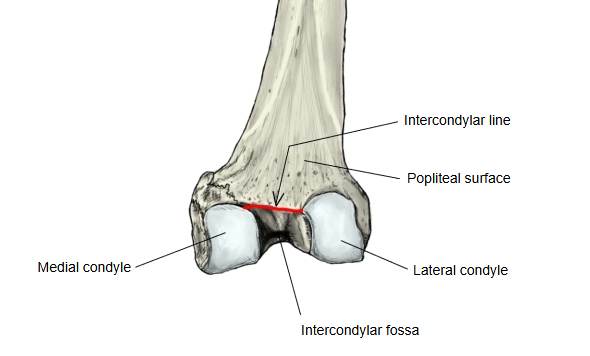
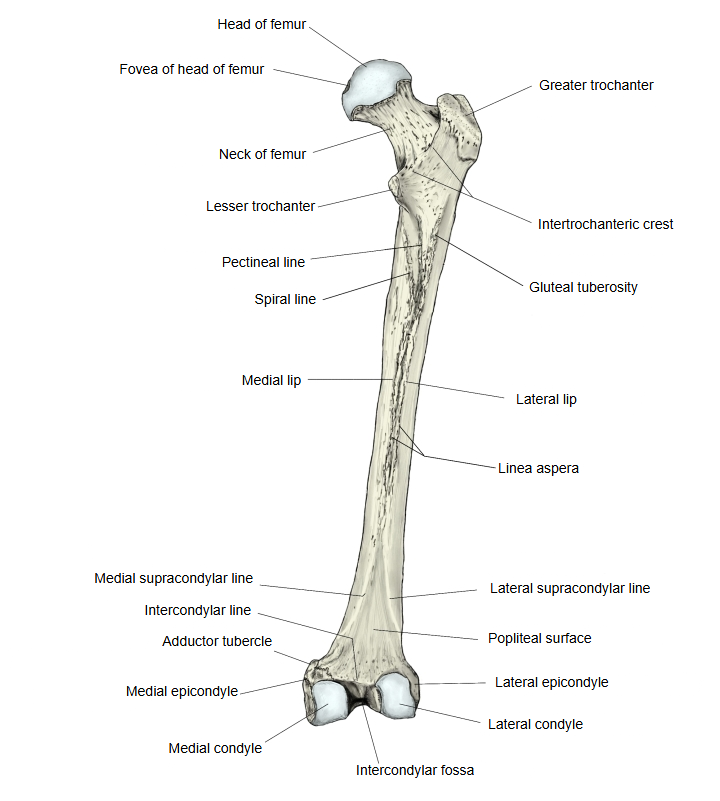
On the femur the intertrochanteric line runs between the two trochanters on the front of the bone and gives attachment to the capsule of the hip joint. The pectineal line runs down the back of the bone from the lesser trochanter and receives the pectineus; the same name is also used for a ridge on the pubis. The linea aspera is the rough line down the middle of the back of the shaft, and the intercondylar line is a low ridge above the intercondylar fossa. Another example is the soleal line of the tibia.
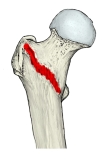 Intertrochanteric line
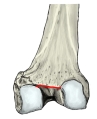 Intercondylar line
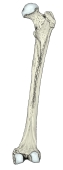 Femur (posterior): pectineal line and linea aspera
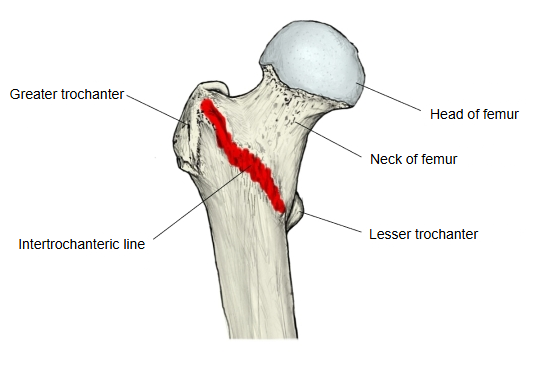
Related terms
References and sources
- Further reading: Anatomical terms of bone, Wikipedia.
- Federative International Programme for Anatomical Terminology (FIPAT). Terminologia Anatomica, 2nd ed. (TA2), 2019.