Linea aspera (Latin: linea aspera)
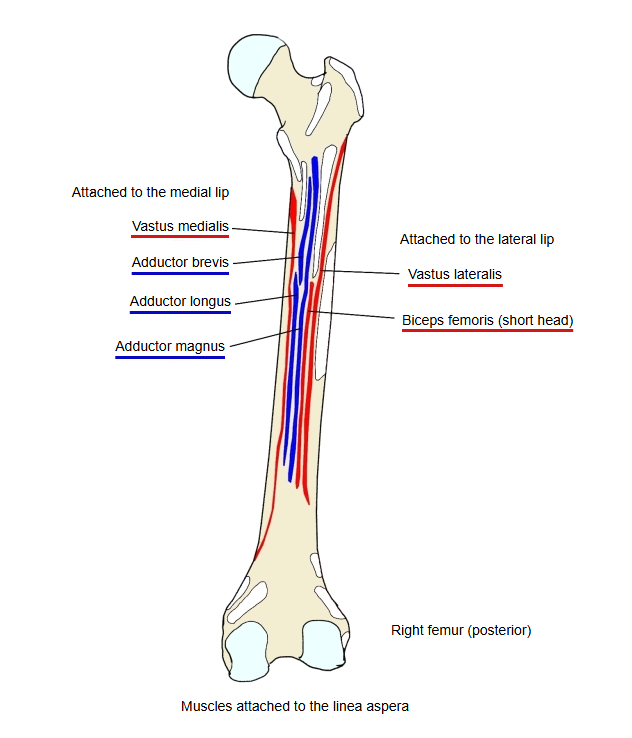
A broad, rough ridge running down the back of the shaft of femur (the name means "rough line"), forming the posterior border of the middle third of the shaft. It consists of a medial lip and a lateral lip, which lie close together in the middle third. It gives origin to vastus medialis, vastus lateralis and the short head of biceps femoris, and insertion to adductor magnus, adductor longus and adductor brevis. The nutrient foramen of the femur usually opens near its middle. The Wikipedia article also describes it as the attachment of the intermuscular septa of the thigh.
- Medial lip : vastus medialis (origin); adductor magnus, adductor longus, adductor brevis (insertion)
- Lateral lip : vastus lateralis, biceps femoris (short head) (origin)
Note: some textbooks also list gluteus maximus among the muscles inserted on the linea aspera, although their own description of gluteus maximus does not name the linea aspera; the muscle is inserted on the gluteal tuberosity, the upward continuation of the lateral lip. Conversely, biceps femoris is sometimes missing from such lists, although its short head arises from the lower half of the lateral lip. Sources differ.
The table below is based on the English Wikipedia article.
| Upper end | 1 | Lateral ridge | Very rough; it forms the gluteal tuberosity and runs up to the base of the greater trochanter. Its upper part is often especially raised and may form a third trochanter. | 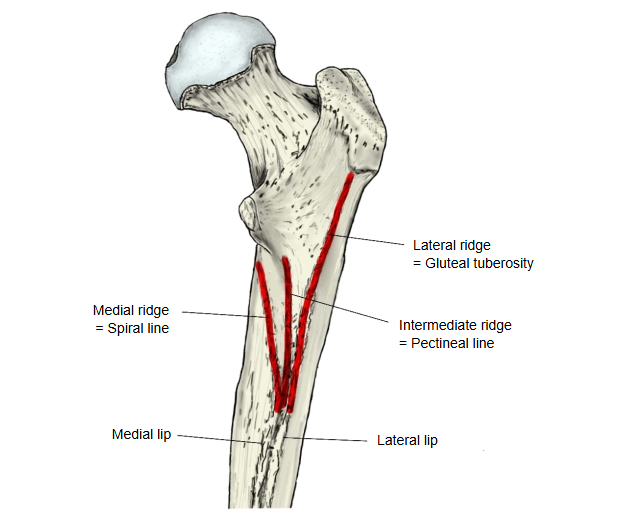 |
| 2 | Intermediate ridge | Called the pectineal line; it runs up to the base of the lesser trochanter. | ||
| 3 | Medial ridge | Called the spiral line; it curves round below the lesser trochanter and continues into the intertrochanteric line. | ||
| Lower end | 1 | Lateral ridge | Becomes the lateral supracondylar line; it is more prominent than the medial one and runs down to the lateral epicondyle, above the lateral condyle. | 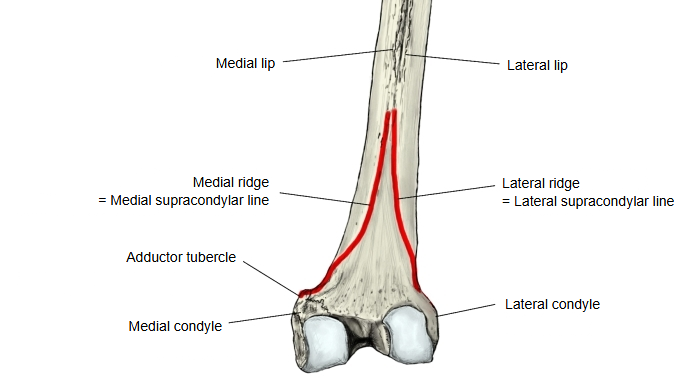 |
| 2 | Medial ridge | Called the medial supracondylar line; less distinct than the lateral line (especially in its upper part), it ends below at the adductor tubercle. The triangle between the two lines is the popliteal surface. |
The linea aspera is a ridge of roughened bone on the back of the femur; besides muscles, the intermuscular septa of the thigh are attached to it.
Medial lip ⇒ the medial femoral intermuscular septum is attached
Lateral lip ⇒ the lateral femoral intermuscular septum is attached
Note: a posterior femoral intermuscular septum is described by some sources but not named by others. Sources differ.
⇒ Cross-section through the middle of the thigh, showing the intermuscular septa attached to the linea aspera (Gray's Anatomy), Wikimedia Commons

⇒ Cross-section of the thigh (diagram), Wikimedia Commons

Reference websites
[Wikipedia]
· Linea aspera, Wikipedia.
· Femur, Wikipedia.
[Websites with illustrations]
· Right femur, posterior surface (Gray's Anatomy) (Wikimedia Commons)

· The femur (TeachMeAnatomy)
Where it is found
Related terms
- Medial lip of linea aspera
- Lateral lip of linea aspera
- Gluteal tuberosity
- Pectineal line of femur
- Medial supracondylar line
- Lateral supracondylar line
- Shaft of femur
References and sources
- Further reading: Linea aspera, Wikipedia.
- Further reading: Femur, Wikipedia.
- Federative International Programme for Anatomical Terminology (FIPAT). Terminologia Anatomica, 2nd ed. (TA2), 2019.