Lingual duct (Latin: ductus lingualis)
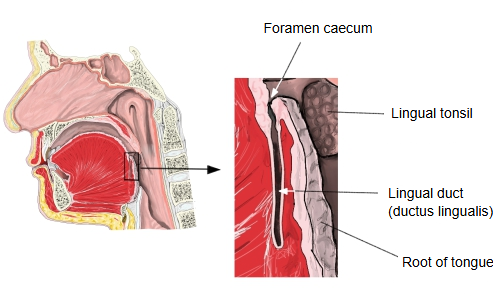
The lingual duct is a short canal continuing from the foramen caecum, which lies at the back end of the midline of the dorsum of the tongue; it is apparently not always present.
Back end of the midline: where the median sulcus ends and the terminal sulcus beginsNot always present: only rarely does the foramen caecum lead into a deep lingual duct
· The short canal that continues from the foramen caecum is called the lingual duct; the ducts of a few lingual glands open into it. It is a remnant of the upper end of the thyroglossal duct, from which the thyroid gland developed.
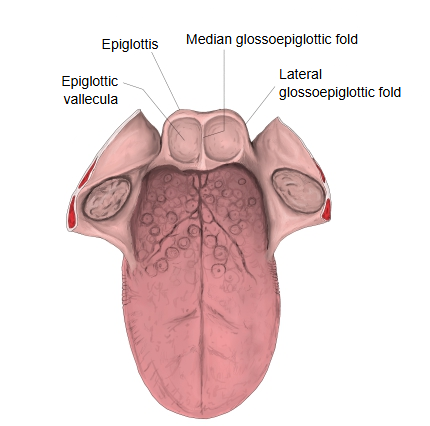
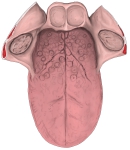 Tongue and epiglottis from above
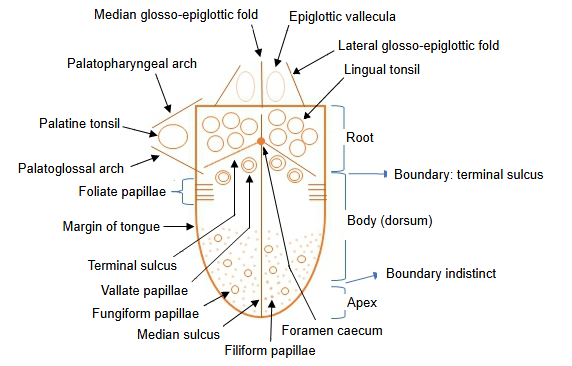
 Tongue (diagram)
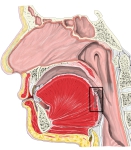 Foramen caecum and lingual duct
Reference websites
[Wikipedia]
· Thyroglossal duct, Wikipedia.
· Tongue, Wikipedia.
[Websites with illustrations]
· Tongue: anatomy, muscles, neurovasculature and histology (Kenhub)
· The mouth cavity with the tongue pulled forward (Gray's Anatomy, fig. 1014) (Wikimedia Commons)

Related terms
- Terminal sulcus of tongue
- Median sulcus of tongue
- Lingual glands
- Root of tongue
- Lingual tonsil
- Tongue
References and sources
- Further reading: Thyroglossal duct, Wikipedia.
- Further reading: Tongue, Wikipedia.
- Federative International Programme for Anatomical Terminology (FIPAT). Terminologia Anatomica, 2nd ed. (TA2), 2019.