Lingual septum (Latin: septum linguae)
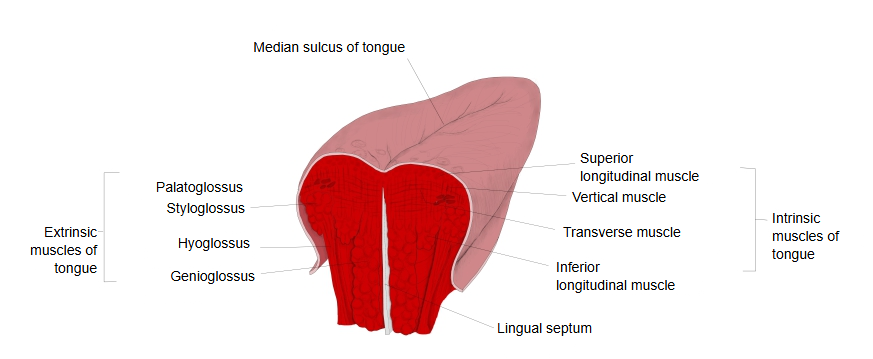
The lingual septum is the partition in the midline inside the tongue; because of it the median sulcus appears on the surface of the tongue.
Partition: a plate of connective tissue containing fatThe septum does not reach the surface of the tongue
· It lies in the median plane between the right and left genioglossus muscles, is attached behind to the hyoid bone, and gives origin to the transverse muscle of the tongue. It divides the muscle of the tongue into right and left halves.
The median sulcus of the tongue is the groove on the surface produced by the lingual septum, the firm partition of connective tissue that runs through the inside of the body of the tongue in the midline. The septum does not quite reach the dorsum of the tongue.
Reference websites
[Wikipedia]
· Tongue, Wikipedia.
[Websites with illustrations]
· Muscles of the tongue (coronal section) (Kenhub)

Related terms
- Root of tongue
- Apex of tongue
- Margin of tongue
- Inferior surface of tongue
- Median sulcus of tongue
- Median glosso-epiglottic fold
- Tongue
- Genioglossus
- Transverse muscle of tongue
- Vertical muscle of tongue
- Superior longitudinal muscle of tongue
- Extrinsic muscles of tongue
References and sources
- Further reading: Tongue, Wikipedia.
- Federative International Programme for Anatomical Terminology (FIPAT). Terminologia Anatomica, 2nd ed. (TA2), 2019.