Inferior surface of tongue (Latin: facies inferior linguae)
Also called the underside of the tongue
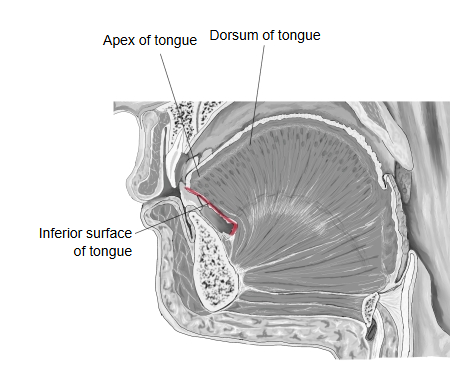
It faces the floor of the mouth and is covered by thin, smooth mucosa without papillae, through which the deep lingual veins show as bluish lines.
Structures seen on and below the inferior surface
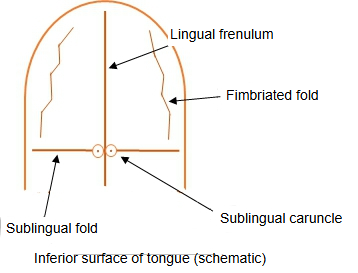
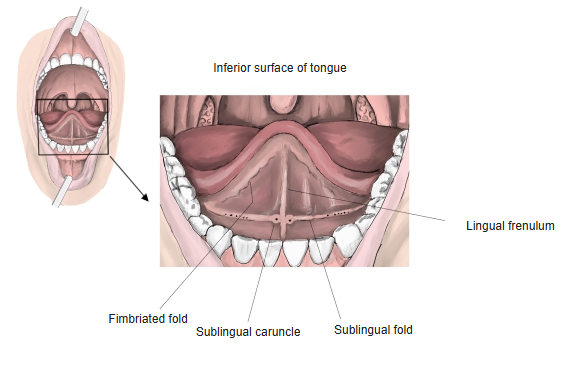
· Lingual frenulum: a fold in the midline of the inferior surface that ties the tongue to the floor of the mouth.
· Sublingual caruncle: a small elevation in the floor of the mouth on each side of the base of the lingual frenulum; the submandibular duct (often joined by the major sublingual duct) opens on it.
· Sublingual fold: a fold running backwards and laterally from the sublingual caruncle in the floor of the mouth, raised by the sublingual gland beneath it; the small ducts of the gland open along it.
· Fimbriated fold (plica fimbriata): a thin, fringed (serrated) fold on each side of the inferior surface, lateral to the deep lingual vein, running forwards towards the tip of the tongue.
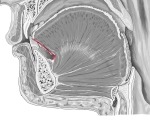 Tongue (median section)
 Inferior surface (diagram)
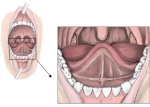 Inferior surface (open mouth)
Reference websites
[Wikipedia]
· Tongue, Wikipedia.
· Frenulum of tongue, Wikipedia.
[Websites with illustrations]
· Frenum: the labial and lingual frenula in the mouth (Cleveland Clinic)
Related terms
- Root of tongue
- Apex of tongue
- Margin of tongue
- Median sulcus of tongue
- Lingual septum
- Median glosso-epiglottic fold
- Tongue
- Lingual frenulum
- Sublingual caruncle
- Sublingual fold
- Floor of mouth
- Sublingual gland
- Deep lingual vein
References and sources
- Further reading: Tongue, Wikipedia.
- Further reading: Frenulum of tongue, Wikipedia.
- Federative International Programme for Anatomical Terminology (FIPAT). Terminologia Anatomica, 2nd ed. (TA2), 2019.