Lumbosacral joint (Latin: articulatio lumbosacralis)
Also called the lumbosacral junction
What is the lumbosacral joint?
Features of the lumbosacral joint
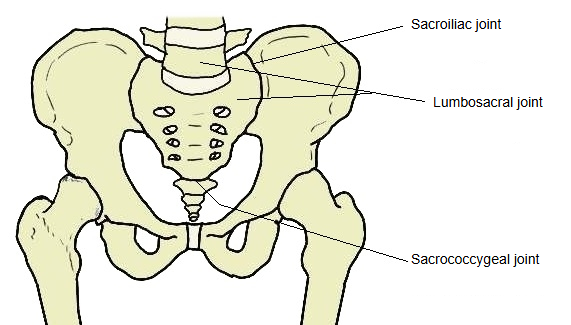
The lumbosacral joint joins the fifth lumbar vertebra with the first sacral vertebra (the base of the sacrum). Its structure is like that of the other joints between vertebrae, but it has some special features. The intervertebral disc lies where the lumbar curve meets the sacral curve and is wedge-shaped, thicker in front than behind. The ligamenta flava between the vertebral arches are well developed. The facet (zygapophysial) joints lie further to the side than those of the other lumbar vertebrae; their articular surfaces face nearer to the coronal plane and are less curved, which helps stop L5 from sliding forwards on the sloping sacrum.
Like other intervertebral connections it has three parts: the intervertebral disc between the vertebral bodies in front, and a right and a left facet joint behind, so calling it a single joint is loose. The projecting front edge of the upper surface of the first sacral vertebra is the promontory. The connection is also held by the iliolumbar ligament, which runs from the transverse process of L5 to the iliac crest.
Reference websites
[Wikipedia]
· Lumbosacral joint, Wikipedia.
Related terms
- Intervertebral disc
- Vertebra
- Base of sacrum
- Promontory (sacrum)
- Lumbar vertebrae
- Sacrum
- Sacroiliac joint
- Sacrococcygeal joint
- Iliolumbar ligament
References and sources
- Further reading: Lumbosacral joint, Wikipedia.
- Federative International Programme for Anatomical Terminology (FIPAT). Terminologia Anatomica, 2nd ed. (TA2), 2019.