Mamillary process (Latin: processus mammillaris)
Also called the mammillary process
Muscles attached: multifidus and the medial lumbar intertransversarii. (This list may not include every muscle attached.)
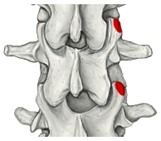 Lumbar spine (posterior)
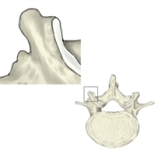 Mammillary and accessory processes (L4)
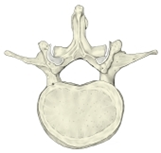 2nd lumbar vertebra (superior)
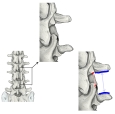 Lumbar intertransversarii
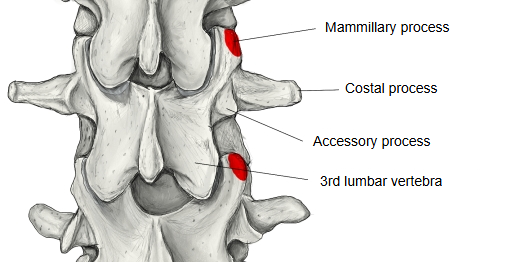
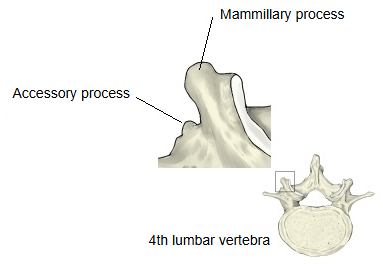
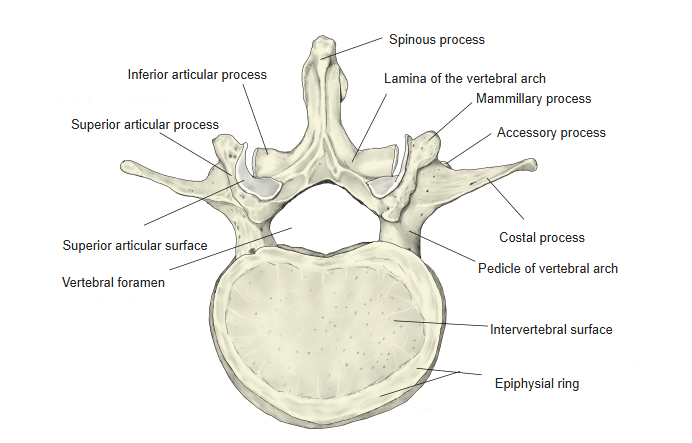
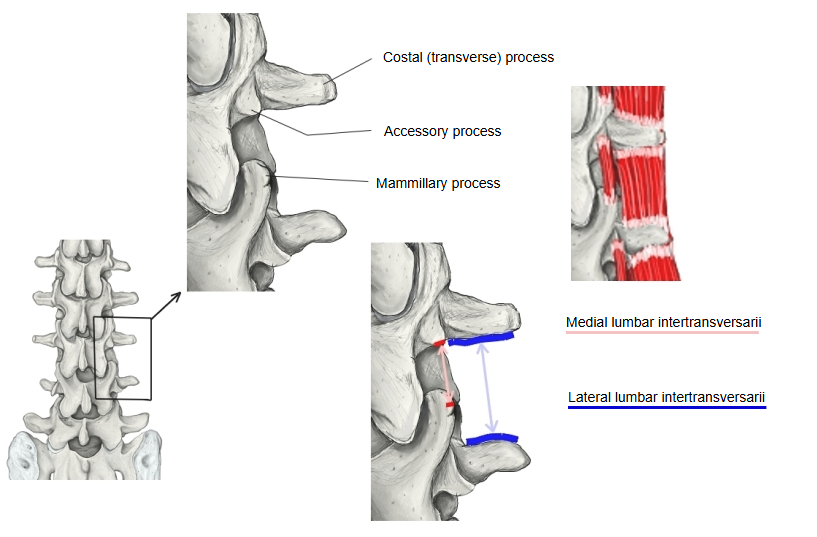
In the lumbar vertebrae the transverse process proper is short and points backwards; it is fused with the outer surface of the superior articular process and does not form a separate process. Part of its tip, the mammillary process, stands out behind the upper part of the outer surface of the superior articular process as a blunt, rounded bump.
It is a small tubercle on the back (dorsal) edge of the superior articular process of each lumbar vertebra, and usually also of the twelfth thoracic vertebra. Together with the accessory process it represents the true transverse process of a lumbar vertebra; the long process to the side is the costal process. It is the main origin of the lumbar part of multifidus, and the medial lumbar intertransversarii link it to the accessory process of the vertebra above.
Reference websites
[Wikipedia]
· Lumbar vertebrae, Wikipedia.
· Multifidus muscle, Wikipedia.
[Websites with illustrations]
· A lumbar vertebra from above and behind (Gray's Anatomy, fig. 93) (Wikimedia Commons)

Where it is found
Related terms
References and sources
- Further reading: Lumbar vertebrae, Wikipedia.
- Further reading: Multifidus muscle, Wikipedia.
- Federative International Programme for Anatomical Terminology (FIPAT). Terminologia Anatomica, 2nd ed. (TA2), 2019.