Costal process (Latin: processus costiformis)
Also called the costiform process
· In origin it corresponds to a rib.
· It is usually longest at L3; at L5 it is short and thick and gives attachment to the iliolumbar ligament.
· Attachments: muscles – quadratus lumborum, psoas major and the lateral lumbar intertransversarii; ligaments – the intertransverse ligaments, which link neighbouring processes, and the iliolumbar ligament (L5). These lists may not be complete.
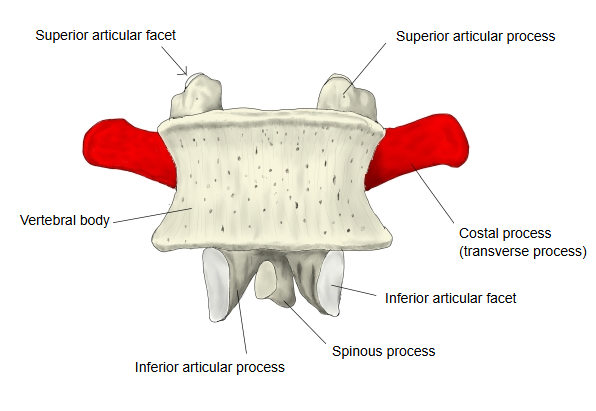
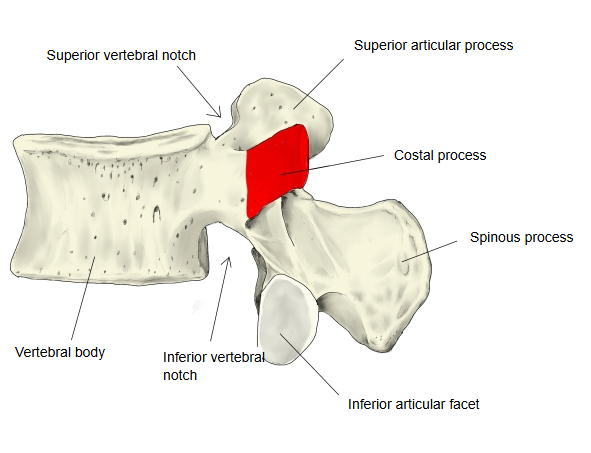
The costal process is the long, flat process that projects sideways from just in front of the accessory process of a lumbar vertebra. It is a rib element that has fused with the vertebra: in the lumbar region no separate rib forms, and this element becomes part of the process. The true transverse process of a lumbar vertebra is represented only by the small accessory process at the back of its root, together with the mamillary process.
Most English texts, illustrations and clinical reports simply call it the transverse process of the lumbar vertebra; "costal process" (costiform process) is the name used in Terminologia Anatomica for this rib element.
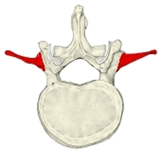 2nd lumbar vertebra (superior)
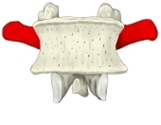 2nd lumbar vertebra (anterior)
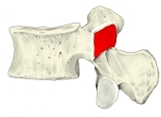 2nd lumbar vertebra (lateral)
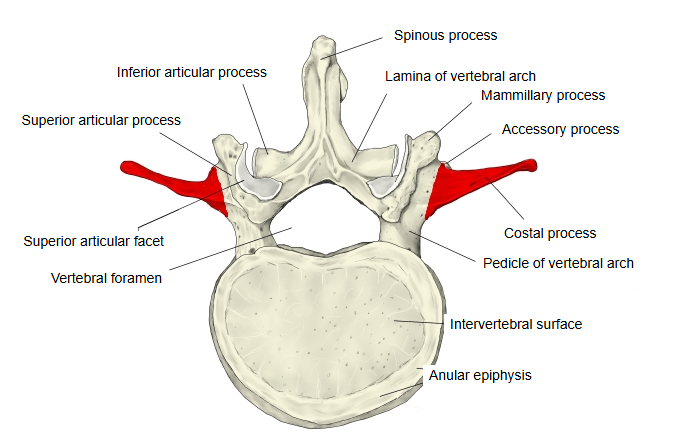
Where it is found
Related terms
References and sources
- Further reading: Lumbar vertebrae, Wikipedia.
- Federative International Programme for Anatomical Terminology (FIPAT). Terminologia Anatomica, 2nd ed. (TA2), 2019.