Spinous process (Latin: processus spinosus)
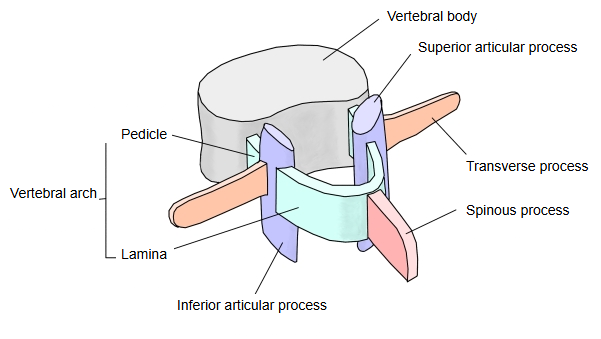
To show how a vertebra is built, its parts are divided below into three groups.
- Vertebral body : joined to the vertebrae above and below through the intervertebral discs.
- Vertebral arch : divided into the pedicles and the laminae.
- Processes : spinous process, transverse processes, superior and inferior articular processes.
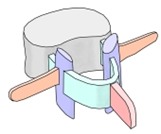 Parts of a vertebra (diagram)
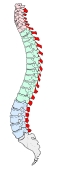 Vertebral column (lateral)
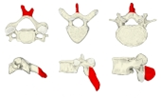 Spinous processes of C4, T6 and L4
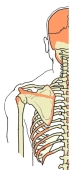 Palpable spinous processes
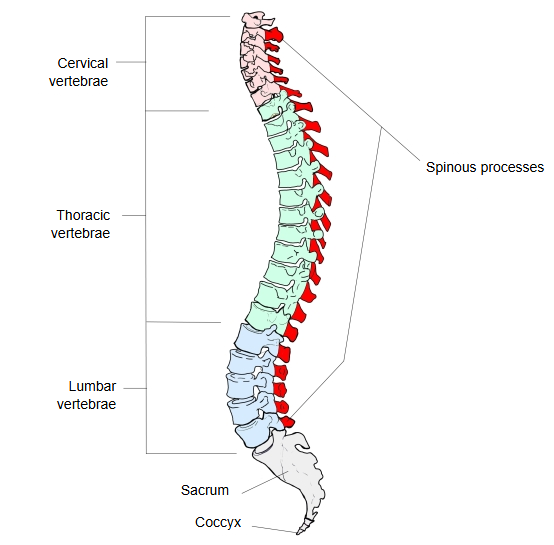
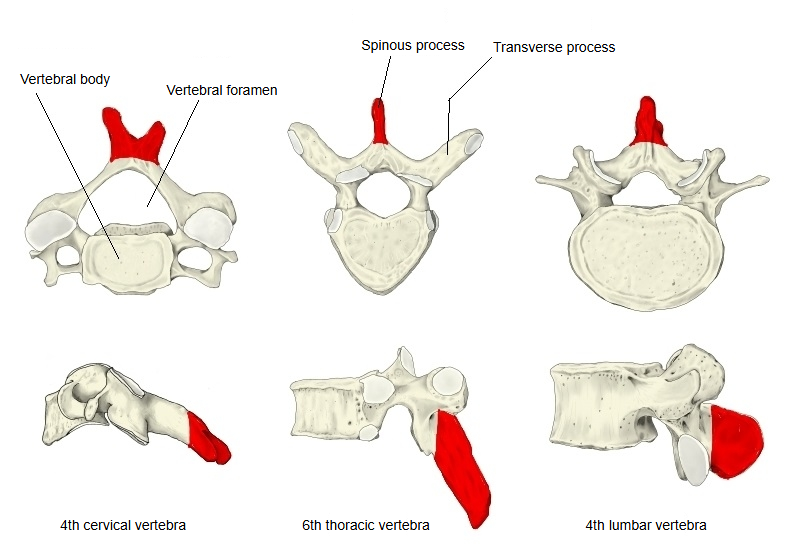
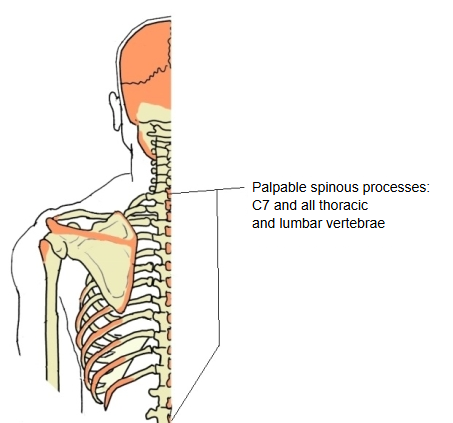
Spinous processes are the bumps that can be felt in a line down the middle of the back. They act as levers for the back muscles and give attachment to muscles and ligaments. Their size, shape and slope differ with the region of the vertebral column.
Cervical vertebrae
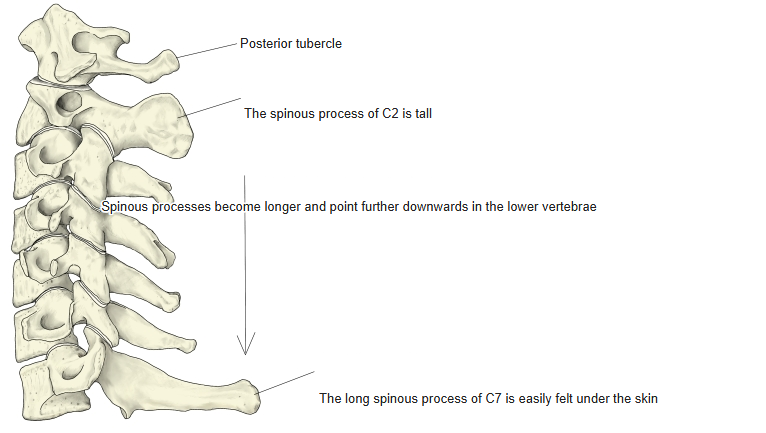
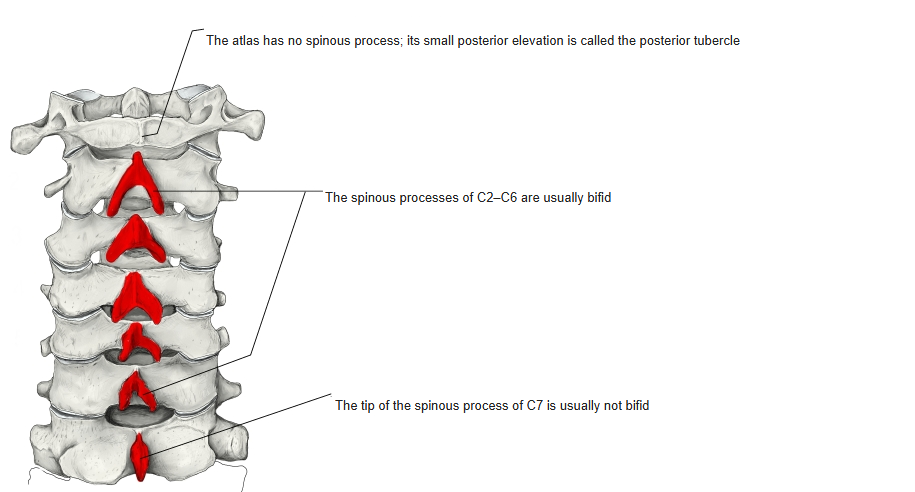
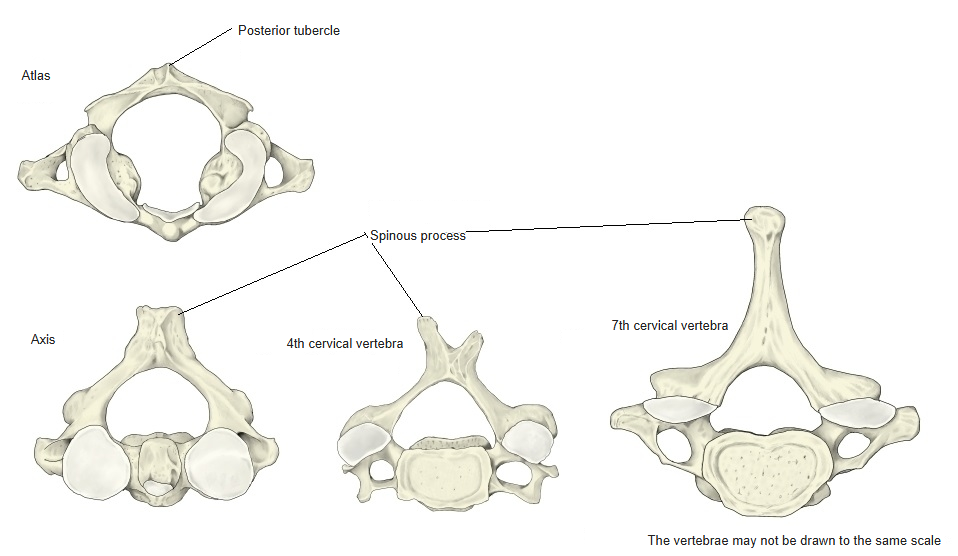
· The atlas (first cervical vertebra) has no spinous process; the small elevation in its place is called the posterior tubercle.
· The spinous process of the axis (C2) is large and broad from top to bottom.
· From C2 to C6 the tip is usually bifid (split in two). At C6 the split is often indistinct, and sources differ on how often C6 is bifid.
· They become longer and slope further downwards and backwards from C2 to C6.
· C7, the vertebra prominens, has a long, thick spinous process that is normally not bifid; it is easily felt under the skin at the base of the neck.
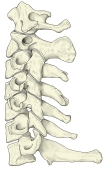 Cervical spine (lateral)
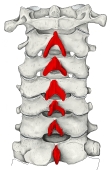 Cervical spine (posterior)
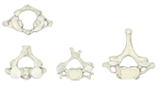 Atlas, axis, C4 and C7 (superior)
Thoracic vertebrae
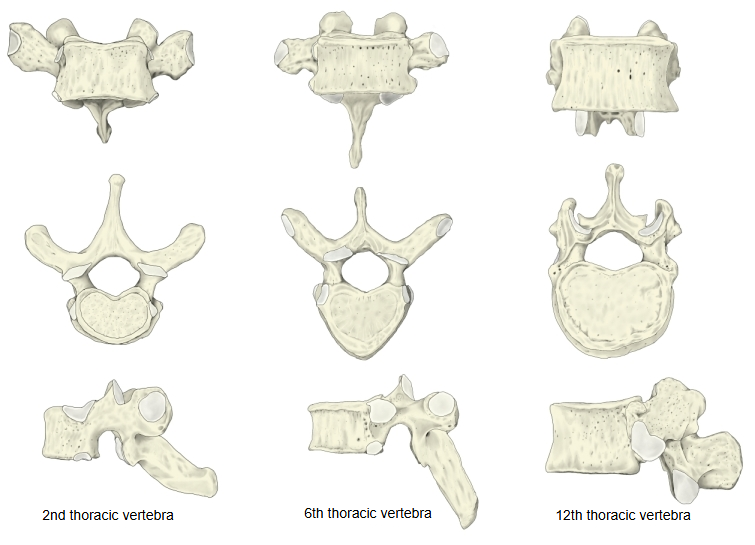
· Long and three-sided, ending in a small knob.
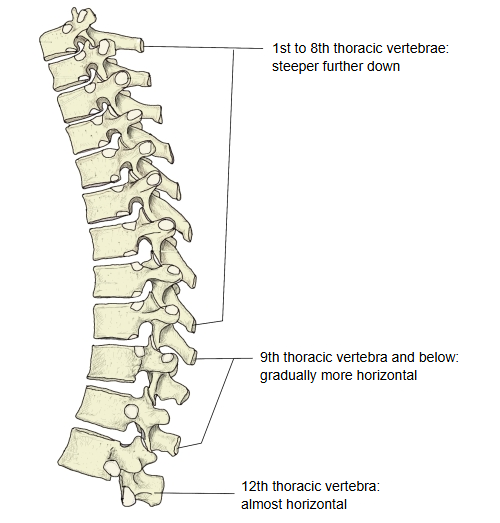
· From T1 to about T8 they slope downwards more and more steeply and overlap like roof tiles; below that they become gradually more horizontal again.
· At T12 the spinous process projects almost horizontally.
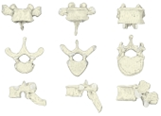 T2, T6 and T12
 Thoracic spine (lateral)
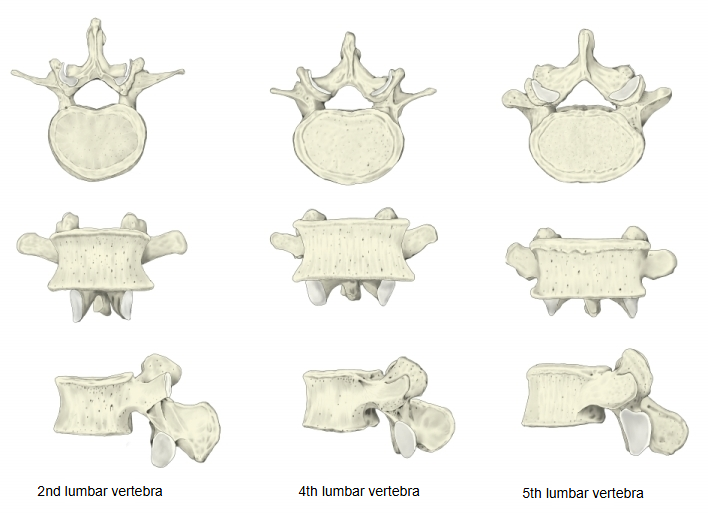
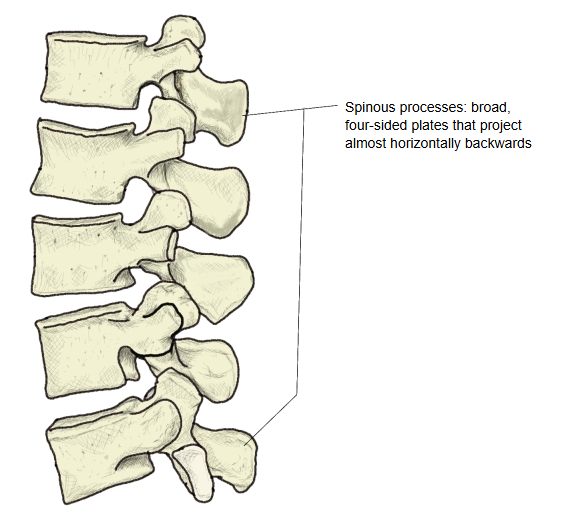
Lumbar vertebrae
· Broad, thick, four-sided plates that are tall from top to bottom.
· They project almost horizontally backwards; the small process of L5 often slopes down a little.
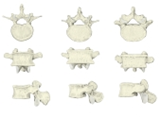 L2, L4 and L5
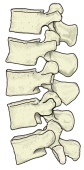 Lumbar spine (lateral)
Muscles
The muscles attached to the spinous processes are listed below; the list may not be complete.
Back muscles
| Muscles arising from spinous processes | |||
| 1 | Trapezius | 8 | Serratus posterior inferior |
| 2 | Latissimus dorsi | 9 | Spinalis |
| 3 | Rhomboid major | 10 | Interspinales |
| 4 | Rhomboid minor | 11 | Rectus capitis posterior major (axis) |
| 5 | Serratus posterior superior | 12 | Obliquus capitis inferior (axis) |
| 6 | Splenius capitis | ||
| 7 | Splenius cervicis | ||
| Muscles inserted on spinous processes | |||
| 1 | Multifidus | 2 | Rotatores |
| 3 | Semispinalis | 4 | Spinalis (also arises from them) |
Ligaments
The ligaments attached to the spinous processes of the vertebrae are listed below; the list may not be complete.
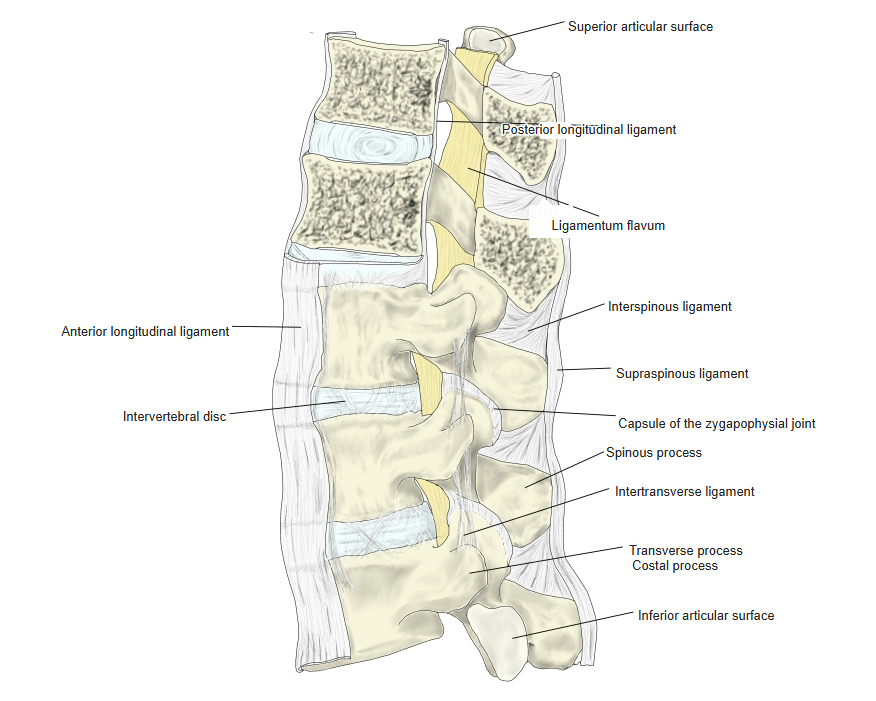
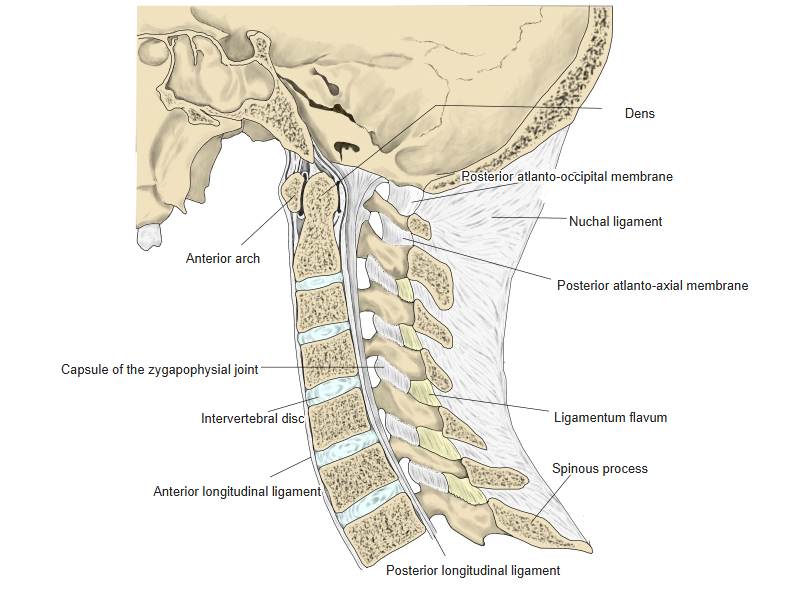
| 1 | Interspinous ligament | Stretches between the spinous processes of neighbouring vertebrae. |
| 2 | Supraspinous ligament | Joins the tips of the spinous processes; in the neck it continues as the nuchal ligament. |
 Ligaments of the lumbar spine
 Ligaments of the cervical spine
The spinous process projects backwards from the point where the two laminae of the vertebral arch meet, and gives attachment to the muscles and ligaments of the spine; it forms the ridge that can be felt through the skin along the back. A sudden forceful pull or twist of the neck and upper back can break off a spinous process. This avulsion fracture, the clay-shoveler's fracture, involves a lower cervical or upper thoracic spinous process, most often C7 or T1 (sometimes C6).
Where it is found
Related terms
- Vertebral body
- Vertebral column
- Vertebra prominens
- Nuchal ligament
- Cervical vertebrae
- Thoracic vertebrae
- Lumbar vertebrae
References and sources
- Further reading: Spinous process, Wikipedia.
- Further reading: Vertebra, Wikipedia.
- Federative International Programme for Anatomical Terminology (FIPAT). Terminologia Anatomica, 2nd ed. (TA2), 2019.