Manubriosternal joint (Latin: symphysis manubriosternalis)
Also called the manubriosternal symphysis or the manubriosternal synchondrosis
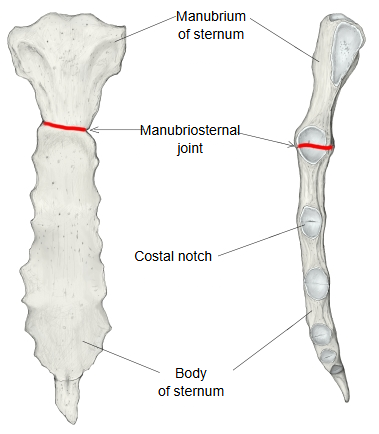
In the adult the facing bone surfaces of the manubrium and the body are covered with a thin layer of hyaline cartilage and joined by a disc of fibrocartilage, which sometimes contains a small cavity. The two parts meet at a slight angle, which forms the sternal angle; the 2nd costal cartilages attach on each side of the joint (see costal notches). The joint allows slight movement during breathing.
In some people, mostly in later life, the joint turns to bone (a synostosis) and can no longer move.
Reference websites
[Wikipedia]
· Sternal angle, Wikipedia.
· Sternum, Wikipedia.
[Websites with illustrations]
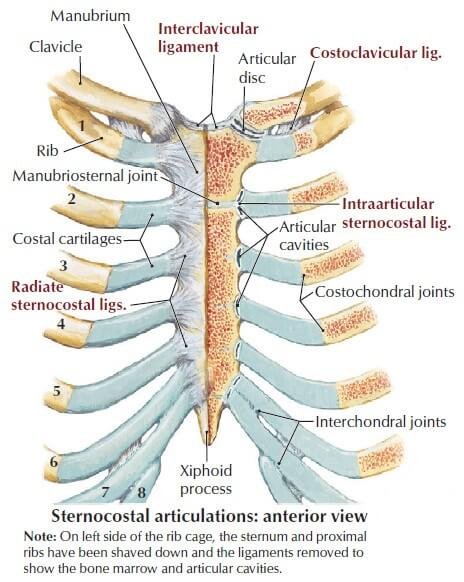
· Sternocostal articulations, anterior view (labelled drawing) (healthfixit.com)
Related terms
References and sources
- Further reading: Sternal angle, Wikipedia.
- Further reading: Sternum, Wikipedia.
- Federative International Programme for Anatomical Terminology (FIPAT). Terminologia Anatomica, 2nd ed. (TA2), 2019.