Sternal angle (Latin: angulus sterni)
Also called the angle of Louis or the manubriosternal angle
· The angle is usually obtuse (about 160°) and varies between people; in thin, frail people it is sharper and more pronounced.
· It can easily be felt through the skin as a transverse ridge.
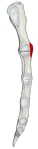 Sternum (right lateral)
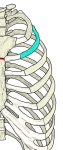 Thoracic cage (left half)
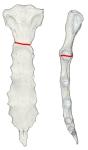 Sternum (anterior and left lateral)
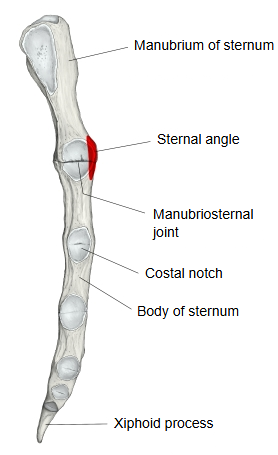
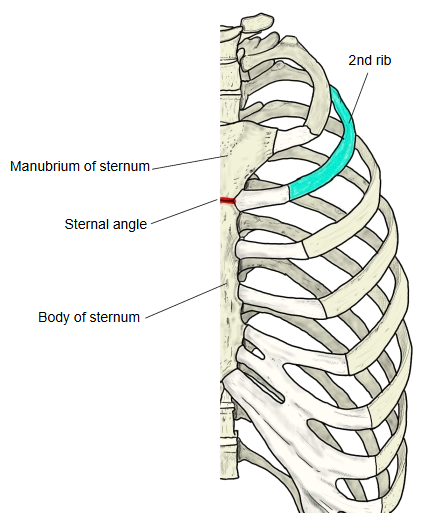
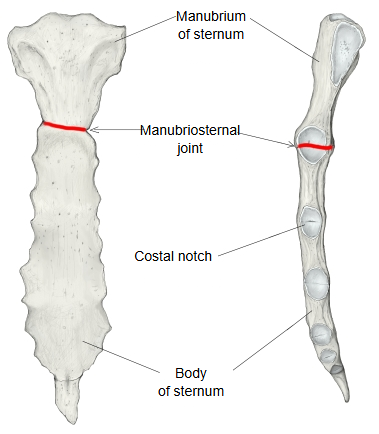
Where the manubrium and the body of the sternum join, the sternum bends slightly forward, and the ridge can be felt from the surface: this is the sternal angle. The 2nd rib (through its costal cartilage) joins the sternum here. The 1st rib cannot be felt from the surface, so in clinical practice the 2nd rib is the starting point for counting the ribs.
It is named after the French physician Pierre Charles Alexandre Louis (1787–1872). The notches at the sides of the junction are where the 2nd costal cartilages articulate. Because the 1st rib is hidden behind the clavicle and can hardly be felt, the sternal angle is the best landmark for identifying the 2nd rib, and so for numbering the ribs. It usually lies at the level of the disc between the 4th and 5th thoracic vertebrae; the horizontal plane through it is the sternal plane (transverse thoracic plane), a useful clinical level that roughly marks the start and end of the arch of the aorta and the bifurcation of the trachea.
Reference websites
[Wikipedia]
· Sternal angle, Wikipedia.
· Sternum, Wikipedia.
[Websites with illustrations]
· The sternum (TeachMeAnatomy)
· Sternum (Kenhub)
· Manubriosternal joint (sternal angle) (Radiopaedia)
Where it is found
Related terms
References and sources
- Further reading: Sternal angle, Wikipedia.
- Further reading: Sternum, Wikipedia.
- Federative International Programme for Anatomical Terminology (FIPAT). Terminologia Anatomica, 2nd ed. (TA2), 2019.