Nasopharynx (Latin: pars nasalis pharyngis)
Also called: nasal part of pharynx; epipharynx
= the epipharynx or the nasal part of the pharynx: the three names are used for the same part.
It is the uppermost part of the pharynx, the part of the throat behind the nose: it lies behind the nasal cavity and above the soft palate. In front it opens into the nasal cavity through the two choanae; below it continues into the oropharynx through the pharyngeal isthmus, which the soft palate closes during swallowing. Its roof and posterior wall lie under the body of the sphenoid and the basilar part of the occipital bone, and carry the pharyngeal tonsil (adenoids). Each lateral wall has the pharyngeal opening of the auditory tube, framed by the torus tubarius, with the pharyngeal recess behind it; through the auditory tube it connects with the middle ear. It carries air only and is lined mainly by ciliated respiratory epithelium. Enlarged adenoids can block nasal breathing and the auditory tube, and nasopharyngeal carcinoma often begins in the pharyngeal recess.
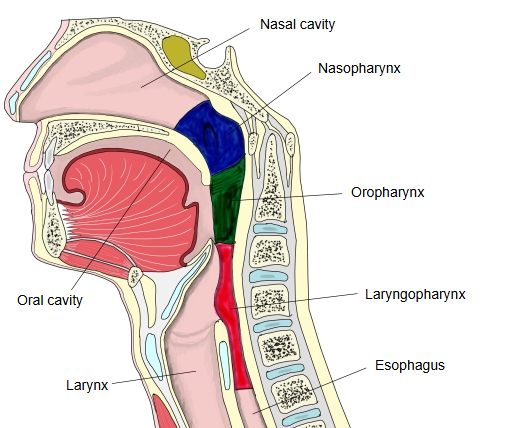
Where it is found
Related terms
- Oropharynx
- Pharyngeal tonsil
- Pharyngeal recess
- Pharyngeal opening of auditory tube
- Choana
- Soft palate
- Pharynx
References and sources
- Further reading: Pharynx, Wikipedia.
- Further reading: Nasopharynx, Wikipedia.
- Federative International Programme for Anatomical Terminology (FIPAT). Terminologia Anatomica, 2nd ed. (TA2), 2019.