Latin: tuba auditiva; tuba auditoria
Overview
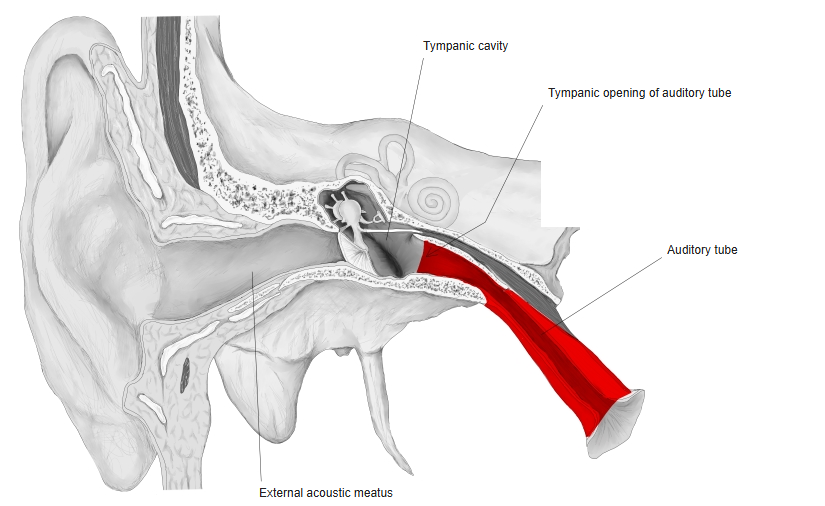
- A canal that connects the tympanic cavity with the nasopharynx; also called the auditory or Eustachian tube.
- About 3.5–4 cm long in the adult; runs forwards, medially and downwards.
- Equalises the air pressure of the middle ear with the outside air and drains secretions to the pharynx.
- Normally closed; it opens briefly during swallowing and yawning.
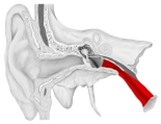
Auditory tube, position 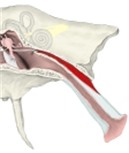
Parts of the auditory tube
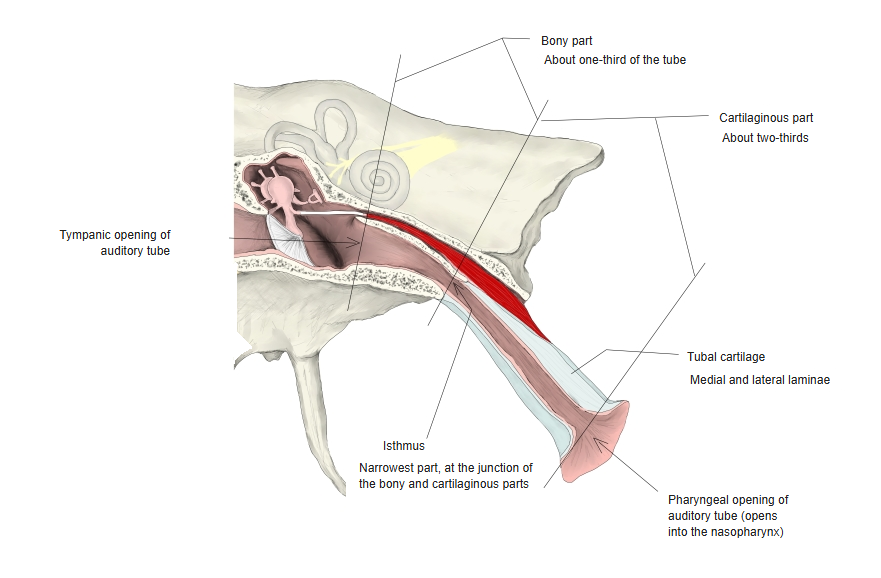
Parts
| Part | Description |
|---|---|
| Bony part (posterolateral one-third) | Canal in the petrous part of the temporal bone; begins at the tympanic opening in the front wall of the tympanic cavity |
| Isthmus | Narrowest point, at the junction of the bony and cartilaginous parts |
| Cartilaginous part (anteromedial two-thirds) | Groove of cartilage (medial and lateral laminae) closed below by membrane; ends at the pharyngeal opening |
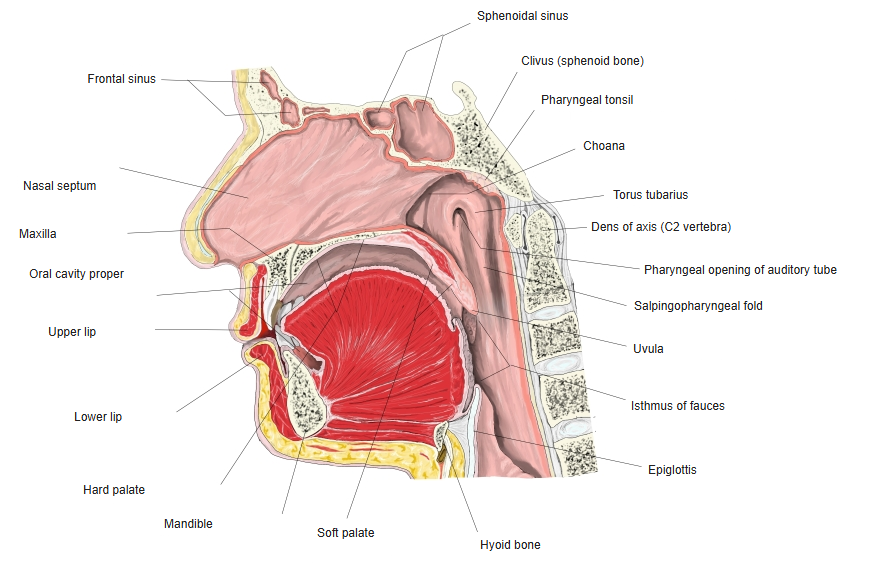
- The pharyngeal opening lies on the lateral wall of the nasopharynx, about 1 cm behind the inferior nasal concha, framed above and behind by the torus tubarius.
- The salpingopharyngeal fold runs down from the torus; lymphoid tissue around the opening forms the tubal tonsil.
Pharyngeal opening of the auditory tube
Opening and clinical notes
- The tensor veli palatini opens the tube during swallowing; the levator veli palatini and salpingopharyngeus also act on it.
- In children the tube is shorter, wider and more horizontal, so infections pass more easily from the throat to the middle ear.
- Blocking of the tube (e.g. with a cold) lowers the pressure in the middle ear and the tympanic membrane is drawn inwards.
References and sources
- Further reading: Pharyngotympanic tube, Wikipedia.