Neck-shaft angle
Also called Angle of inclination of the femur
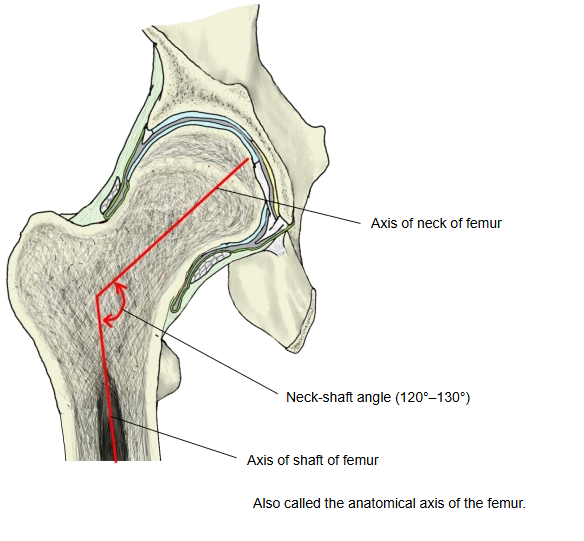
The neck-shaft angle is the angle between the long axis of the shaft of femur and the long axis of the neck of femur, measured in the frontal plane (seen from the front). In adults it is usually about 125°; quoted normal ranges vary (roughly 120°–135°).
Body weight passes from the head through the neck to the shaft, so the neck carries especially large forces; the load is greatest on its lower (medial) side, where the compact bone is particularly thick. The angle changes with age and sex. It is largest in early childhood (about 150°–160°) and becomes smaller as the pelvis widens during growth. It tends to be slightly smaller in women, whose pelvis is wider and whose femur is shorter. The neck is flattened from front to back and widens towards the shaft. The angle carries the shaft clear of the pelvis and lets the femur slope inwards towards the knee, giving the hip joint a wide range of movement. An abnormally small angle is called coxa vara; an abnormally large one, coxa valga.
Note: the neck-shaft angle (in the frontal plane) is different from the angle of femoral torsion, or anteversion, which is measured in the horizontal plane.
angle
(smaller
with age)
- Infants : the largest angle; the neck runs steeply up from the shaft.
- Young children : about 160°
- Adults : about 120°–130° (smaller in women than in men)
Reference websites
· Femoral angles (figure), Quia.
Related terms
References and sources
- Further reading: Femoral neck, Wikipedia.
- Further reading: Coxa vara, Wikipedia.
- Federative International Programme for Anatomical Terminology (FIPAT). Terminologia Anatomica, 2nd ed. (TA2), 2019.