Shaft of femur (Latin: corpus femoris)
Also called the body of femur
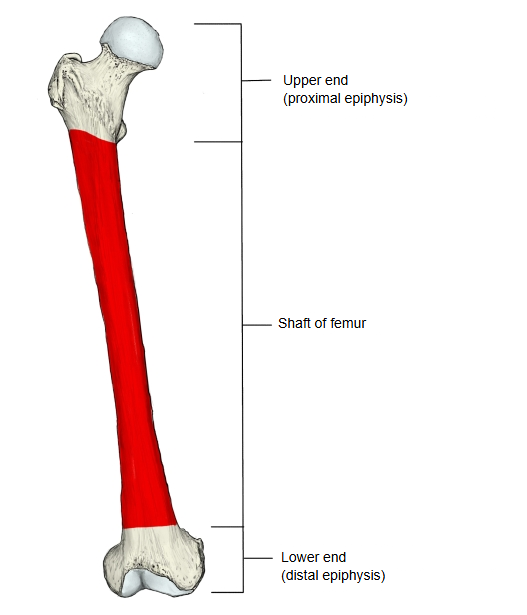
The shaft of the femur is one of the three parts of the femur: the long, tubular middle part (the diaphysis) between the upper and lower ends. Many thigh muscles attach to it, mainly along the linea aspera on its back.
- Upper end : (proximal epiphysis): marked by the projecting neck and head of the femur, with the greater and lesser trochanters.
- Shaft : (body of femur): the tubular part that forms the diaphysis.
- Lower end : (distal epiphysis): much broader than the upper end, with the two condyles and epicondyles.
The following describes the shape of the shaft: the three surfaces and three borders of its middle third, and the features of its upper and lower thirds.
The shaft is roughly cylindrical: narrowest in the middle, thicker above, and widening from side to side towards the knee; it is bowed slightly forwards. In standing it slopes downwards and medially, at about 10° to the vertical, so the knees lie closer together than the hips. In its middle third it has three borders and three surfaces. The medial and lateral borders are rounded and indistinct. All three surfaces are smooth: the anterior surface lies between the medial and lateral borders and is convex forwards; the lateral surface lies between the lateral and posterior borders and faces backwards more than laterally; the medial surface lies between the medial and posterior borders and faces medially and slightly backwards. The posterior border is the broad, rough ridge called the linea aspera. Its raised medial and lateral edges are the medial lip and the lateral lip, and the nutrient foramen usually opens between or near them.
of the
middle third
- Anterior surface : between the medial and lateral borders; convex forwards.
- Medial surface : between the medial and posterior borders; faces medially and slightly backwards.
- Lateral surface : between the lateral and posterior borders; faces backwards more than laterally.
of the
middle third
- Medial border : rounded.
- Lateral border : rounded.
- Posterior border : rough: the linea aspera.
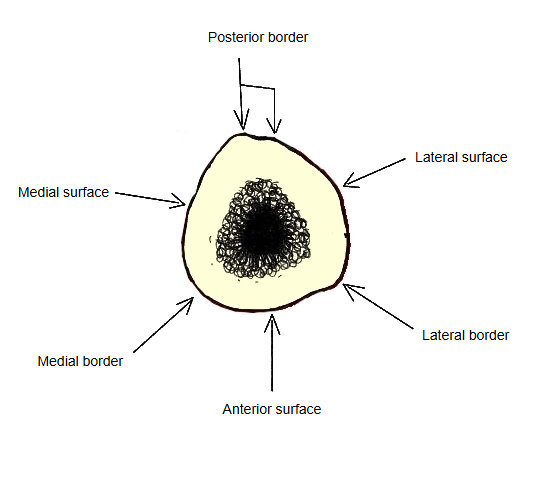
· Cross-section of the thigh (Wikimedia Commons): a picture that shows the section through the middle third

· Cross-section through the middle of the thigh, Gray's Anatomy fig. 432 (Wikimedia Commons): a picture that shows the section through the middle third

In the upper third the linea aspera spreads out into three ridges, so the back of the shaft widens into an inverted triangle. The medial ridge is the thin spiral line, which continues below into the medial lip and above into the lower end of the intertrochanteric line, curving round below the lesser trochanter. The intermediate ridge, running from the medial lip to the base of the lesser trochanter, is the pectineal line. The broad, rough lateral ridge, running from the lateral lip upwards and laterally to the base of the greater trochanter, is the gluteal tuberosity; its upper end is sometimes raised as a third trochanter. In the lower third the shaft is flattened from front to back and widens into a broad, three-sided lower end. The medial lip runs down to the back of the medial condyle as the medial supracondylar line, ending at the adductor tubercle; the lateral lip runs down to the lateral epicondyle as the lateral supracondylar line. The shallow, smooth triangle between them is the popliteal surface, which forms the floor of the upper popliteal fossa. The upper part of the medial supracondylar line is faint where the femoral artery crosses obliquely to the back of the thigh.
The following muscles attach to the shaft of the femur: origins in red and insertions in blue. Some of these attachments extend onto the upper end of the femur.
| 1 | vastus lateralis | 1 | gluteus maximus | 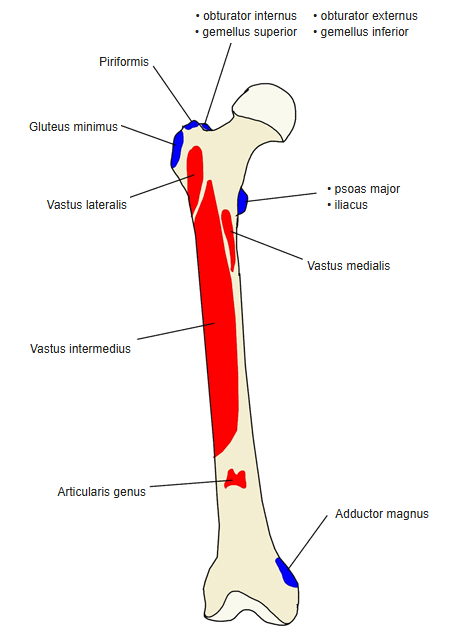 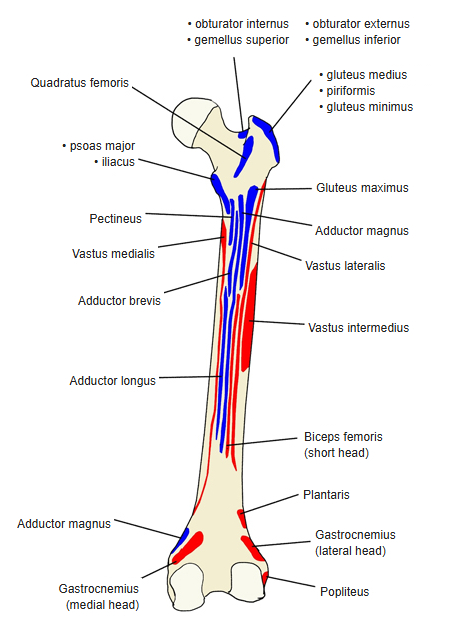 |
| 2 | biceps femoris (short head) | 2 | adductor magnus | |
| 3 | vastus intermedius | 3 | adductor brevis | |
| 4 | vastus medialis | 4 | pectineus | |
| 5 | adductor longus | |||
The following features are found on the shaft of the femur.
| 1 | Lateral lip | labium laterale | 3 | Linea aspera | linea aspera |
| 2 | Popliteal surface | facies poplitea | 4 | Medial lip | labium mediale |
Where it is found
Related terms
- Linea aspera
- Medial lip of linea aspera
- Lateral lip of linea aspera
- Gluteal tuberosity
- Popliteal surface
- Proximal epiphysis of femur
- Distal epiphysis of femur
References and sources
- Further reading: Femur, Wikipedia.
- Further reading: Linea aspera, Wikipedia.
- Federative International Programme for Anatomical Terminology (FIPAT). Terminologia Anatomica, 2nd ed. (TA2), 2019.