Nuchal region
Also called: nape of the neck
The nuchal region
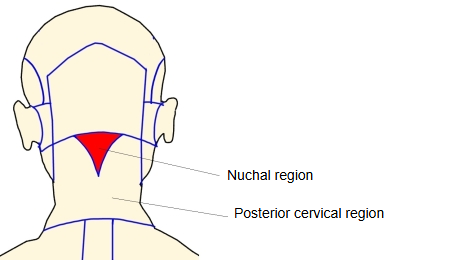
It is the small, roughly triangular upper central part of the posterior cervical region, directly below the external occipital protuberance and the superior nuchal line. The occipital region lies above it; the triangle narrows downwards in the midline. Beneath the skin lie the upper parts of trapezius, splenius capitis and semispinalis capitis, with the nuchal ligament in the midline. Sources differ: many texts use "nuchal region" and "posterior cervical region" as two names for the whole back of the neck.
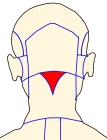 Nuchal region (back view)
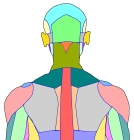 Regions of the back of the head, neck and upper back
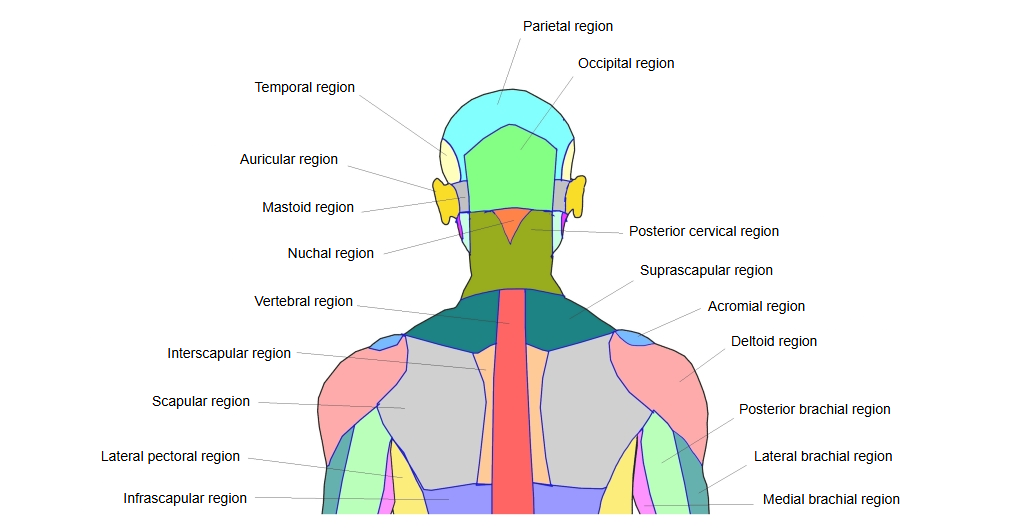
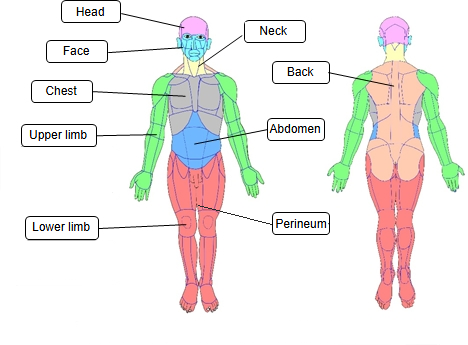
On this site the body is divided into three main parts, the head and neck, the trunk and the limbs, and the limbs into the upper and lower limbs. Each part is divided further into smaller regions.
of the
body
- Head and neck : 1. head (head, face) 2. neck
- Trunk : 1. chest 2. abdomen 3. back
- Limbs
- Upper limb : 1. shoulder 2. arm 3. elbow 4. forearm 5. hand
- Lower limb : 1. perineum 2. thigh 3. knee 4. leg 5. foot
| Neck (16) | |||
| 1 | Anterior cervical region (anterior neck region) | 9 | Submandibular region |
| 2 | Submental region | 10 | Carotid triangle |
| 3 | Hyoid region | 11 | Sternocleidomastoid region |
| 4 | Infrahyoid region | 12 | Lesser supraclavicular fossa |
| 5 | Laryngeal region | 13 | Lateral cervical region |
| 6 | Thyroid region | 14 | Omoclavicular triangle (= greater supraclavicular fossa) |
| 7 | Tracheal region | 15 | Posterior cervical region |
| 8 | Jugular fossa | 16 | Nuchal region |
Related terms
- Posterior cervical region
- Superior nuchal line
- External occipital protuberance
- Trapezius
- Splenius capitis
- Semispinalis capitis
References and sources
- Further reading: Nape, Wikipedia.
- Federative International Programme for Anatomical Terminology (FIPAT). Terminologia Anatomica, 2nd ed. (TA2), 2019.