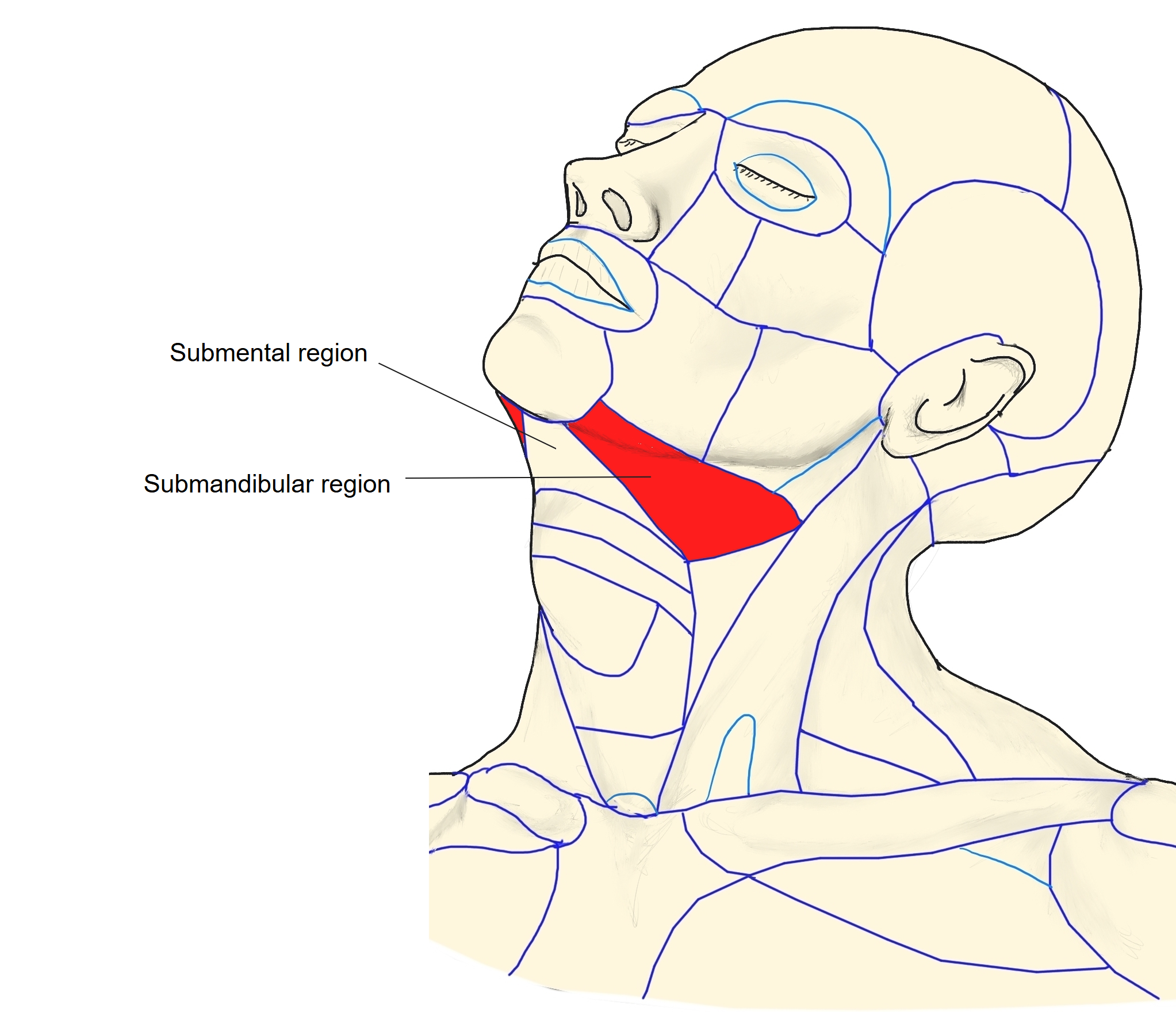
Submandibular region (Latin: trigonum submandibulare)
Also called: submandibular triangle; digastric triangle
It lies on each side of the upper neck, below the body of the mandible, and corresponds to the submandibular (digastric) triangle. Its boundaries are the lower border of the mandible above, the anterior belly of the digastric in front and its posterior belly (with the stylohyoid) behind. Its floor is formed by the mylohyoid and the hyoglossus; the roof is skin, the platysma and deep fascia. It contains most of the submandibular gland, the submandibular lymph nodes, the facial artery and facial vein, and the hypoglossal and mylohyoid nerves. Systems of body regions differ between sources; some name this area only as the submandibular (digastric) triangle.
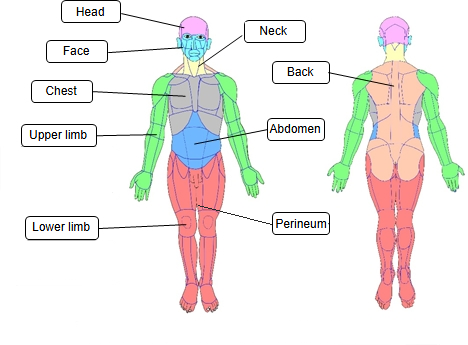
On this site the body is divided into three main parts, the head and neck, the trunk and the limbs, and the limbs into the upper and lower limbs. Each part is divided further into smaller regions.
of the
body
- Head and neck : 1. head (head, face) 2. neck
- Trunk : 1. chest 2. abdomen 3. back
- Limbs
- Upper limb : 1. shoulder 2. arm 3. elbow 4. forearm 5. hand
- Lower limb : 1. perineum 2. thigh 3. knee 4. leg 5. foot
Related terms
- Submental region
- Submental triangle
- Carotid triangle
- Submandibular gland
- Digastric
- Mylohyoid
- Facial artery
References and sources
- Further reading: Submandibular triangle, Wikipedia.
- Federative International Programme for Anatomical Terminology (FIPAT). Terminologia Anatomica, 2nd ed. (TA2), 2019.