Opsonization
Also called Opsonisation
The binding of certain proteins to a foreign body that has entered the body, such as a bacterium or virus (an antigen), which makes it easier to attack.
More details
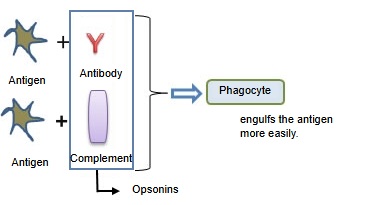
When antibodies or complement bind to an antigen, such as a virus or bacterium that has entered the body, the antigen is taken up more easily by phagocytes. This is opsonization, also called the opsonin effect.
The proteins of the blood that coat the target in this way are called opsonins. They bind to the surface of the target, and receptors on the phagocyte recognize them, so that the target is engulfed more readily.
Main opsonins
The main opsonins are the following:
| 1 | C3b | A fragment of complement. Acts early in an infection, before specific antibodies have been made. |
| 2 | IgG | Immunoglobulin G, a class of antibody. Becomes important once IgG antibodies against the microbe have been made, especially in a repeat infection. |
Opsonization by complement
C3b is formed when complement is activated, by any of its three pathways (classical, alternative and lectin). It is deposited on the surface of the microbe, and complement receptors on the phagocyte bind to it.
Opsonization by antibodies
IgG binds strongly to the pathogen. When enough IgG is bound, receptors on the phagocyte for the Fc part of IgG (Fc receptors) recognize the pathogen with its IgG and the phagocyte engulfs it more actively.
Reference websites
[Wikipedia]
· Opsonin, Wikipedia.
Related terms
References and sources
- Further reading: Opsonin, Wikipedia.
- Federative International Programme for Anatomical Terminology (FIPAT). Terminologia Anatomica, 2nd ed. (TA2), 2019.