Phagocyte (Latin: phagocytus)
Members of the white blood cell family that protect the body from invaders such as bacteria and viruses: they swallow them up and destroy them.
More details
A phagocyte is any cell that has phagocytosis, the ability to engulf and digest what the body does not need (non-self). There are three categories:
| 1 | Monocytes and macrophages |
| 2 | Neutrophils (polymorphonuclear white blood cells) |
| 3 | Dendritic cells |
What the body does not need (non-self) includes not only viruses and bacteria that have entered from outside, but also tumour cells, dead or damaged cells and worn-out red blood cells. Neutrophils act quickly and die after their work; macrophages live longer and, like dendritic cells, also present fragments of what they have digested to lymphocytes.
The process of phagocytosis
A simple outline of the steps:
| 1 | 2 | 3 |
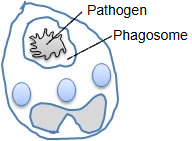
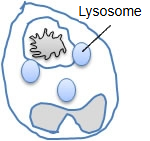
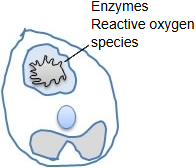
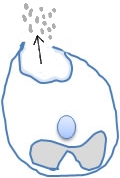
| The cell engulfs the particle. The space formed around it is called the phagosome. | A lysosome in the cell approaches the phagosome. | The lysosome fuses with the phagosome to form a phagolysosome and releases its enzymes into it; reactive oxygen species are also made there. |
 |  |  |
| 4 | 5 | |
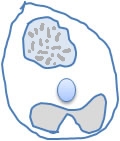
| The enzymes and reactive oxygen species break the particle down into small pieces. | The phagolysosome, now holding only indigestible remains (a residual body), moves to the cell membrane, fuses with it and releases the remains out of the cell (exocytosis). | |
 |  |
Related terms
References and sources
- Further reading: Phagocyte, Wikipedia.
- Further reading: Phagocytosis, Wikipedia.
- Federative International Programme for Anatomical Terminology (FIPAT). Terminologia Anatomica, 2nd ed. (TA2), 2019.