Palmar aponeurosis (Latin: aponeurosis palmaris)
Also called: palmar fascia (central part)
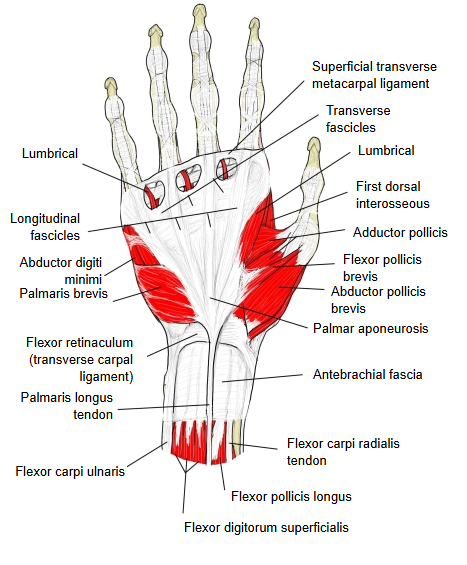
The palmar aponeurosis is a strong, triangular sheet of dense fibrous tissue in the centre of the palm, lying just under the skin; it is the thickened central part of the deep fascia of the palm, and the fascia over the thenar and hypothenar muscles at the sides is much thinner. Its apex at the wrist is continuous with the flexor retinaculum and receives the tendon of palmaris longus when that muscle is present. Each slip sends superficial fibres to the skin of the palm and of the finger creases, and deeper fibres that pass on either side of the flexor tendons to the fibrous flexor sheaths and the deep transverse metacarpal ligament. Near the bases of the fingers the transverse fibres form the transverse fascicles, and across the finger webs runs the superficial transverse metacarpal ligament.
Deep to it lie the superficial palmar arch, the long flexor tendons and the branches of the median and ulnar nerves; the gaps between the slips transmit the digital vessels and nerves and the lumbricals. From its edges, fibrous septa pass deeply and separate the central compartment of the palm from the thenar and hypothenar compartments, and palmaris brevis arises from its medial (ulnar) border. It protects the structures beneath it and anchors the palmar skin, which helps grip. Thickening and shortening of the aponeurosis (Dupuytren's contracture) gradually pulls the fingers, most often the ring and little fingers, into flexion.
Reference websites
[Wikipedia]
· Palmar aponeurosis, Wikipedia.
· Dupuytren's contracture, Wikipedia.
Where it is found
Related terms
- Palmaris longus
- Flexor retinaculum (hand)
- Superficial palmar arch
- Superficial transverse metacarpal ligament
- Deep transverse metacarpal ligament
- Lumbricals (hand)
References and sources
- Further reading: Palmar aponeurosis, Wikipedia.
- Further reading: Dupuytren's contracture, Wikipedia.
- Federative International Programme for Anatomical Terminology (FIPAT). Terminologia Anatomica, 2nd ed. (TA2), 2019.