Sphincter of Oddi (Latin: musculus sphincter ampullae hepatopancreaticae)
Also called the hepatopancreatic sphincter or the sphincter of hepatopancreatic ampulla
Note: not every part is present in everyone (the sphincter of the pancreatic duct and the sphincter of the ampulla are often weak or absent), so some sources do not describe the sphincter of Oddi as having three parts.
of Oddi
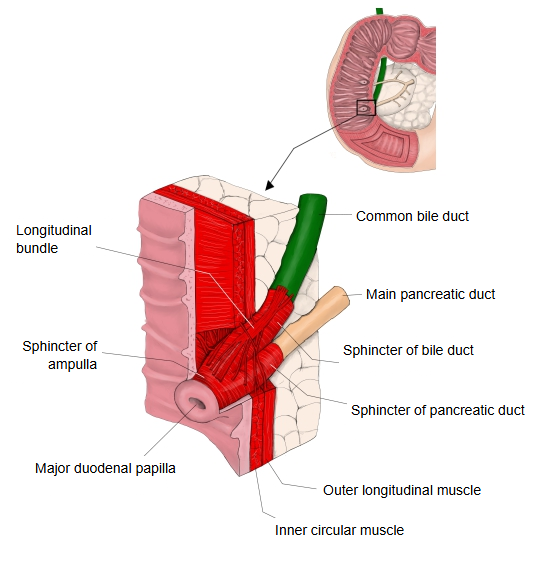
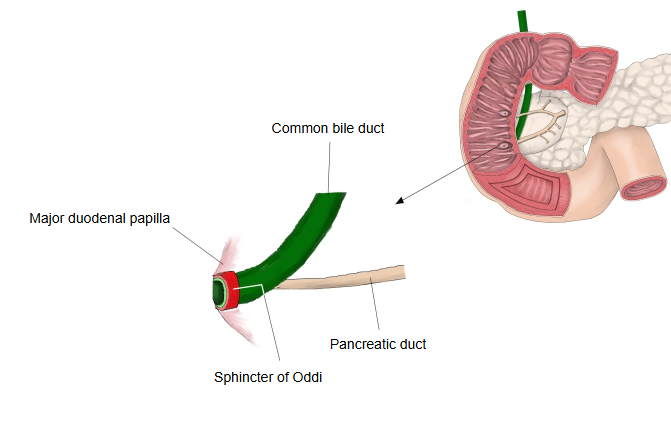
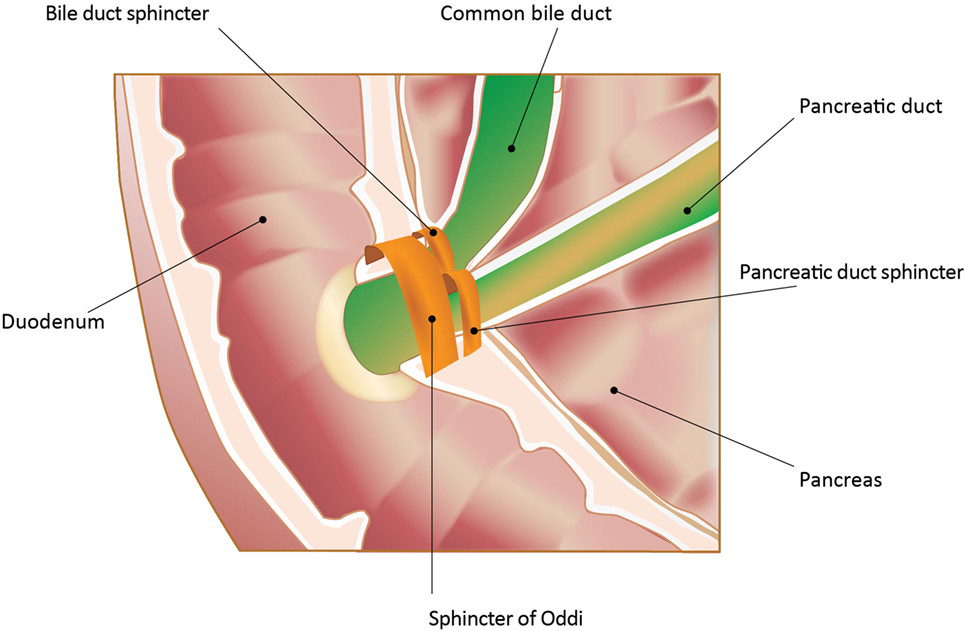
- Sphincter of the bile duct : the smooth muscle around the end of the common bile duct just before it joins the pancreatic duct (choledochal sphincter). The strongest and most constant part; its closure is what fills the gallbladder.
- Sphincter of the pancreatic duct : the smooth muscle around the end of the main pancreatic duct just before the two ducts join. Present in only some people and often joined to the bile duct sphincter.
- Sphincter of the ampulla : the smooth muscle around the hepatopancreatic ampulla, the common channel formed where the two ducts unite in the major duodenal papilla. Often weak or absent.
Sources differ on how often each part is present, partly because the two ducts may join to form an ampulla or open separately on the papilla.
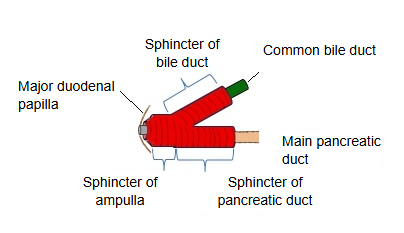
· It is also called the hepatopancreatic sphincter. The name sphincter of the hepatopancreatic ampulla (Terminologia Anatomica) is also used for the whole sphincter, although in the narrow sense it means only the part around the ampulla (the sphincter of the ampulla, above). It is named after the Italian anatomist Ruggero Oddi, who described it in 1887.
· It lies in the wall of the second (descending) part of the duodenum and is about 1 cm long. Its muscle is separate from the muscle coat of the duodenum.
· It controls the flow of bile and pancreatic juice into the duodenum and helps prevent duodenal contents from flowing back into the ducts.
· Between meals it stays contracted, so bile backs up into the gallbladder to be stored. After a meal the hormone cholecystokinin relaxes the sphincter as the gallbladder contracts.
· During ERCP the sphincter can be cut (endoscopic sphincterotomy) to remove bile duct stones. Sphincter of Oddi dysfunction is a cause of biliary-type pain without stones.
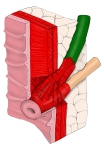 Duodenal wall at the papilla
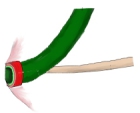 Common bile duct and pancreatic duct
Reference websites
[Wikipedia]
· Sphincter of Oddi, Wikipedia.
· Ampulla of Vater, Wikipedia.
[Websites with illustrations]
· Bile and pancreatic ducts with the sphincter of Oddi (figure) (Frontiers in Nutrition)
· Pancreatic duct system (figure) (MUSC Health)

· Gallbladder and bile ducts (figure) (Dentistry Key)

· Sphincter of Oddi (Radiopaedia)
Where it is found
Related terms
- Common bile duct
- Pancreatic duct
- Accessory pancreatic duct
- Cystic duct
- Common hepatic duct
- Duodenum
- Gallbladder
References and sources
- Further reading: Sphincter of Oddi, Wikipedia.
- Further reading: Ampulla of Vater, Wikipedia.
- Federative International Programme for Anatomical Terminology (FIPAT). Terminologia Anatomica, 2nd ed. (TA2), 2019.