Interlobular duct (Latin: ductus interlobularis)
· Ducts of the same name occur in the salivary glands and the mammary gland; in the liver, the interlobular bile ducts run between the lobules in the same way.
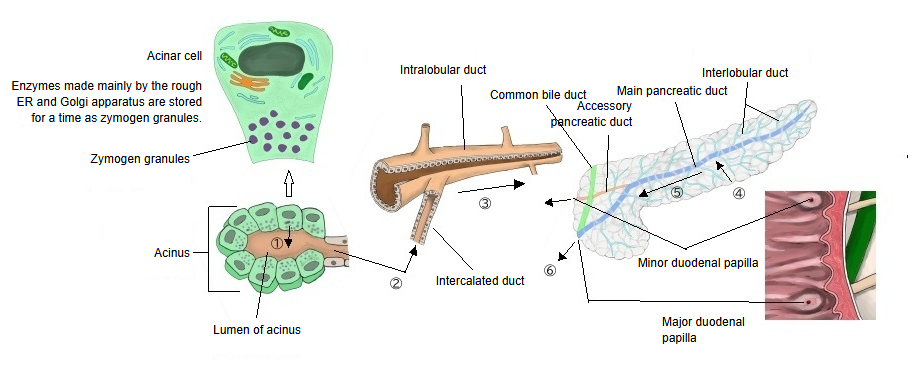
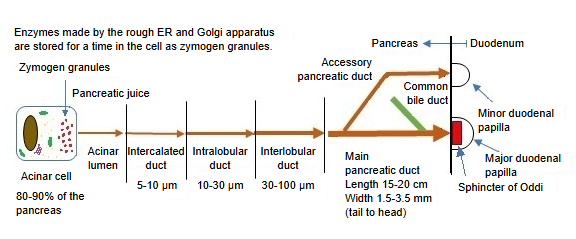
· In the pancreas, pancreatic juice flows from the acinus through the intercalated duct and the intralobular duct into the interlobular duct, and from there into the main or accessory pancreatic duct.
· It runs in the interlobular connective tissue between the lobules and is lined by cuboidal to low columnar epithelium, which becomes taller as the ducts join and widen. In the pancreas it is roughly 30–100 µm across, wider than the intralobular ducts (about 10–30 µm) and intercalated ducts (about 5–10 µm); sources differ on the exact sizes.
Related terms
- Intralobular duct
- Pancreatic juice
- Intercalated duct
- Pancreatic duct
- Main pancreatic duct
- Accessory pancreatic duct
- Interlobular connective tissue
- Acinar cells
- Interlobular bile duct
References and sources
- Further reading: Pancreas, Wikipedia.
- Further reading: Exocrine gland, Wikipedia.
- Federative International Programme for Anatomical Terminology (FIPAT). Terminologia Anatomica, 2nd ed. (TA2), 2019.