Perilymphatic duct (Latin: ductus perilymphaticus)
Also called Aqueduct of cochlea (often used for the canal that contains it)
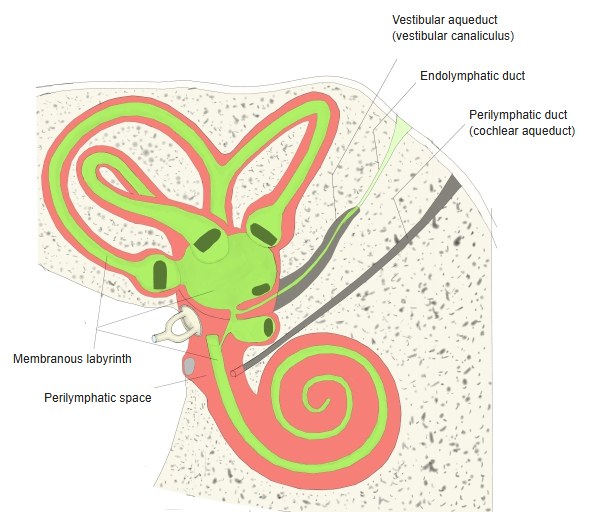
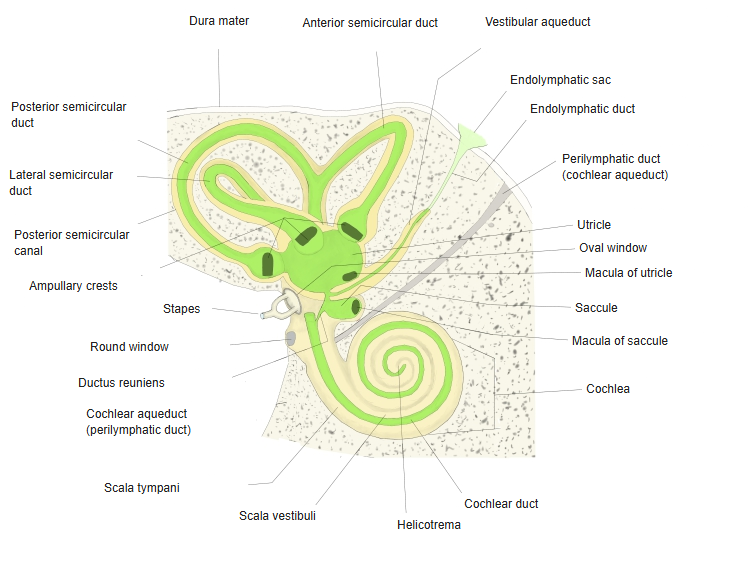
The name means a duct of the bony labyrinth that contains perilymph, but in practice it refers to the channel in the aqueduct of the cochlea. It begins in the scala tympani of the basal turn of the cochlea, near the round window, and runs to the external aperture of the canal at the posterior border of the inferior surface of the petrous temporal bone, beside the jugular foramen; there it opens into the subarachnoid space of the posterior cranial fossa, which reaches the aperture around the glossopharyngeal nerve. Through it, perilymph is continuous with cerebrospinal fluid; because the duct is long and narrow, pressure changes in the cerebrospinal fluid normally have little effect on the inner ear. It runs roughly parallel to the endolymphatic duct but is not connected with it; the vein of the cochlear aqueduct runs nearby. Sources differ on whether the duct is a true tube or a loose network of connective tissue within the canal, and on how often it is fully open in adults.
- Internal acoustic meatus : not a part of the labyrinth but the canal for its nerves: from the internal acoustic opening to the fundus (four areas: upper front, upper back, lower back, lower front).
- Bony labyrinth : three parts: the cochlea, the vestibule and the semicircular canals. Between it and the membranous labyrinth lies the perilymphatic space, filled with perilymph; it gives off the perilymphatic duct, which communicates with the subarachnoid space.
- Membranous labyrinth : organ of hearing: the cochlear duct; organ of balance: the saccule, the utricle and the semicircular ducts. Its inside (the endolymphatic space) is filled with endolymph.
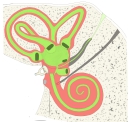 Perilymphatic space and membranous labyrinth
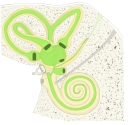 Bony and membranous labyrinth
Reference websites
[Wikipedia]
· Perilymphatic duct, Wikipedia.
· Cochlear aqueduct, Wikipedia.
[Websites with illustrations]
· The inner ear (TeachMeAnatomy)
· Longitudinal section of the cochlea (Gray's Anatomy, fig. 928) (Wikimedia Commons)

Related terms
References and sources
- Further reading: Perilymphatic duct, Wikipedia.
- Further reading: Cochlear aqueduct, Wikipedia.
- Federative International Programme for Anatomical Terminology (FIPAT). Terminologia Anatomica, 2nd ed. (TA2), 2019.