Perimysium
Also called: internal perimysium
A muscle is wrapped by three kinds of connective-tissue sheath:
of a
muscle
- Endomysium : loose connective tissue around each muscle fiber (muscle cell).
- Perimysium : loose connective tissue around each fascicle (a bundle of a few to several dozen muscle fibers).
- Epimysium : dense connective tissue around the whole muscle, which is made of many fascicles.
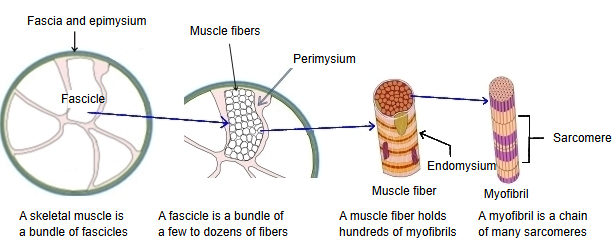
 Connective-tissue sheaths of a muscle
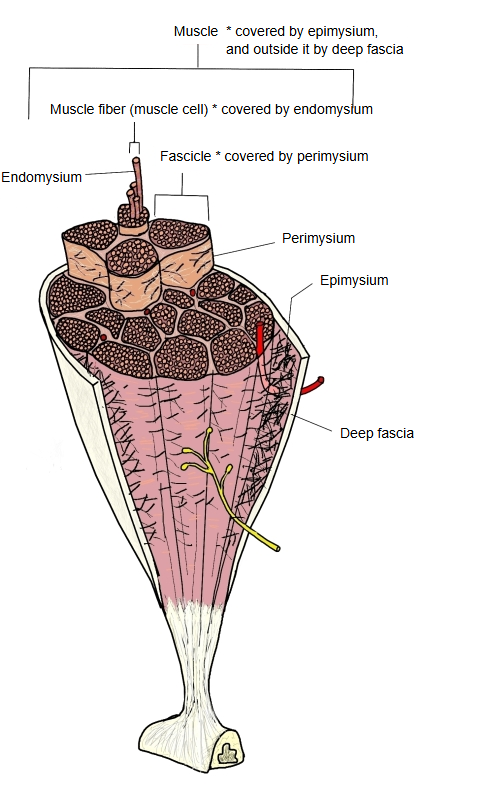
The next figure shows how the three muscle sheaths fit into the wider meaning of fascia. Note that Terminologia Anatomica does not recommend dividing fascia into superficial fascia and deep fascia in this way.
- Superficial fascia : the subcutaneous tissue, containing blood vessels, nerves, lymph nodes and fat.
- Deep fascia : membranes of connective tissue deep to the subcutaneous tissue that cover the deeper structures; broadly of two kinds: 1. membranes that wrap the muscles directly (muscular fascia): endomysium, perimysium, epimysium; 2. membranes that wrap the organs and vessels (visceral fascia).
· superficial fascia ⇒ subcutaneous tissue
· deep fascia ⇒ muscular fascia and visceral fascia
How a muscle is built up from its fibers:
A muscle is made of many muscle fibers (muscle cells) bound together by loose connective tissue. Each fiber is wrapped by endomysium; a number of fibers are bundled into a fascicle by the loose perimysium (internal perimysium); and the surface of the whole muscle is covered by the dense, strong epimysium (external perimysium), with the deep fascia outside it. At its two ends a muscle usually passes into a tendon that attaches to bone or to a ligament. A tendon is connective tissue made mainly of collagen fibers, built of tendon bundles held together by an internal and external peritendineum; in the muscles of the trunk the tendon is often spread out as a flat sheet, the aponeurosis.
Reference websites
[Wikipedia]
· Perimysium, Wikipedia.
[Websites with illustrations]
· Structure of a skeletal muscle (illustration) (Wikimedia Commons)

· Skeletal muscle (illustration) (Wikimedia Commons)

Related terms
References and sources
- Further reading: Perimysium, Wikipedia.
- Federative International Programme for Anatomical Terminology (FIPAT). Terminologia Anatomica, 2nd ed. (TA2), 2019.