Dendritic cell
Also called DC
One of the immune cells that protect the body against outside invaders such as viruses and bacteria, and against cancer cells.
- Dendritic cells
- Granulocytes
- Monocytes : → macrophages
- Lymphocytes
- B cells : → plasma cells
- NK cells
- T cells
More details
Dendritic cells (DCs) are a kind of white blood cell that develops from haematopoietic stem cells in the bone marrow; as the name says, they stretch out processes all round and have a tree-like shape. They are the most efficient antigen-presenting cells.
There are also cells of a similar branched shape that do not present antigen to T cells, such as the follicular dendritic cells of lymphoid follicles. They come from stromal cells and are now usually regarded as distinct from the dendritic cells above.
⇒ See the lineage chart of the haematopoietic stem cell.
<Where they are found>
They are found not only in lymphoid tissue but throughout the body, especially where tissues easily meet the outside world: the skin first of all, the lining of the nasal cavity, the stomach and the intestinal tract. They take up antigens in the tissues, carry them to the lymph nodes and present them to T cells.
<Types>
| T-cell-related dendritic cells | ||
| 1 | Myeloid (conventional) dendritic cell | The main antigen-presenting type |
| 2 | Plasmacytoid dendritic cell | Resembles a plasma cell; responds mainly to viruses |
| 3 | Langerhans cell | In the stratum spinosum of the epidermis ⇒ details |
| 4 | Interdigitating dendritic cell | In the T-cell areas of lymph nodes and other lymphoid organs |
| 5 | Veiled cell | Dendritic cells on their way through the afferent lymph vessels |
| 6 | Dermal dendritic cell | In the dermis |
| B-cell-related dendritic cells | ||
| 1 | Germinal-centre (follicular) dendritic cell | In the lymphoid follicles and germinal centres; hold antigens for B cells (from stromal cells; often counted as a separate cell type) |
| 2 | Antigen-transporting cell | Carries antigens |
<Functions>
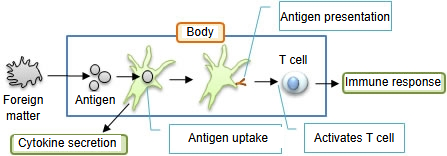
| 1 | Activating T cells |
| They take in invading antigens with their branching processes, break them down and present them on the cell surface to T cells, which activates the T cells and strengthens the immune response. | |
| 2 | Secreting cytokines |
| They secrete cytokines, signalling proteins that direct the immune response against viruses and other invaders. |
⇒ Website with an electron micrograph I

⇒ Website with an electron micrograph II
⇒ Website with an electron micrograph III

Websites used
· Dendritic cell, Wikipedia
Related terms
- Lymphoid tissue
- Langerhans cell
- White blood cell
- Hematopoietic stem cell
- B lymphocyte
- Plasma cell
- Germinal center
- Lymph node
- Stratum spinosum
References and sources
- Further reading: Dendritic cell, Wikipedia.
- Federative International Programme for Anatomical Terminology (FIPAT). Terminologia Anatomica, 2nd ed. (TA2), 2019.