Pleural recesses (Latin: recessus pleurales)
Also called Pleural recess or the pleural sinuses
See the pleural recesses under Pleura.
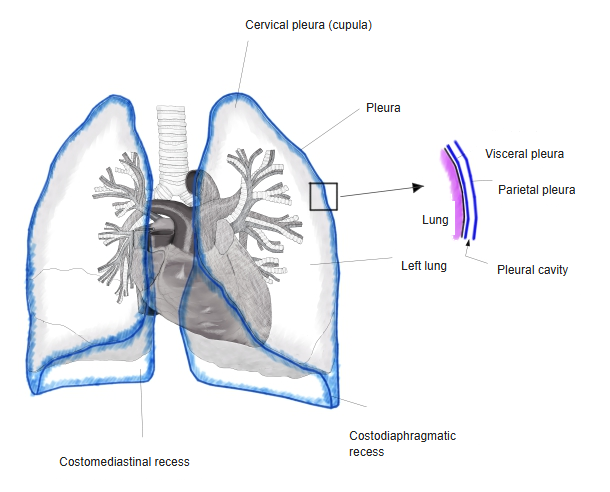
The pleural recesses are narrow spaces of the pleural cavity where one part of the parietal pleura turns sharply into another, so that the two layers lie close together with no lung between them. The costodiaphragmatic recess, the largest, lies around the lower edge of the diaphragm, where the diaphragmatic pleura turns into the costal pleura. The costomediastinal recess lies behind the front of the chest wall, where the costal pleura turns into the mediastinal pleura; it is larger on the left, beside the heart. In quiet breathing the lung does not fill the recesses; in deep inspiration it moves into them. Some sources also name smaller recesses, such as the phrenicomediastinal and vertebromediastinal recesses.
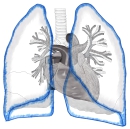 Pleura and pleural recesses
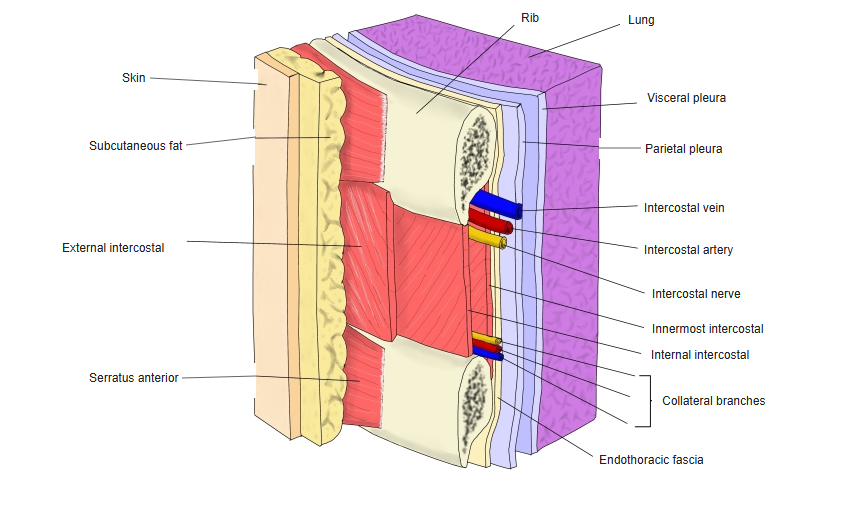
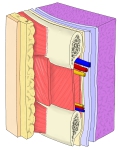 Layers of the thoracic wall
Related terms
- Costodiaphragmatic recess
- Costomediastinal recess
- Pleural cavity
- Parietal pleura
- Costal pleura
- Diaphragmatic pleura
- Pleura
References and sources
- Further reading: Pleural cavity, Wikipedia.
- Federative International Programme for Anatomical Terminology (FIPAT). Terminologia Anatomica, 2nd ed. (TA2), 2019.