Pleural cavity (Latin: cavitas pleuralis)
· There are two pleural cavities, right and left, separated by the mediastinum; they do not communicate.
· Normally it is only a potential space: the thin film of serous fluid lets the lung slide smoothly against the wall. The fluid's surface tension and the slightly negative pressure in the space keep the lung pressed against the wall, so the lung follows the chest as it expands.
· Air (pneumothorax), fluid (pleural effusion) or blood (haemothorax) entering the space lets the lung collapse away from the wall.
· Where the parietal pleura turns from one surface to another, the cavity forms recesses that the lung fills only in deep inspiration: the costodiaphragmatic recess, the lowest part around the edge of the diaphragm, where fluid collects first, and the costomediastinal recess at the front, behind the sternum (larger on the left).
- Pulmonary regions : right and left; each holds a lung, surrounded by the pleural cavity (the space between the visceral and parietal pleura).
- Mediastinum
- Superior : thymus, brachiocephalic veins, superior vena cava (upper part), aortic arch, trachea and others.
- Inferior : heart, superior vena cava (lower part) and the end of the inferior vena cava, pulmonary veins, main bronchi and others.
- Common to both : oesophagus and vagus nerves; sympathetic trunks and aorta; azygos vein and thoracic duct.
layer of
the pleura
- Parietal pleura : the outer layer (on the side of the ribs).
- Pleural cavity : the very narrow space enclosed by the two layers; it holds a small amount of serous fluid.
- Visceral pleura : the inner layer (on the side of the lung).
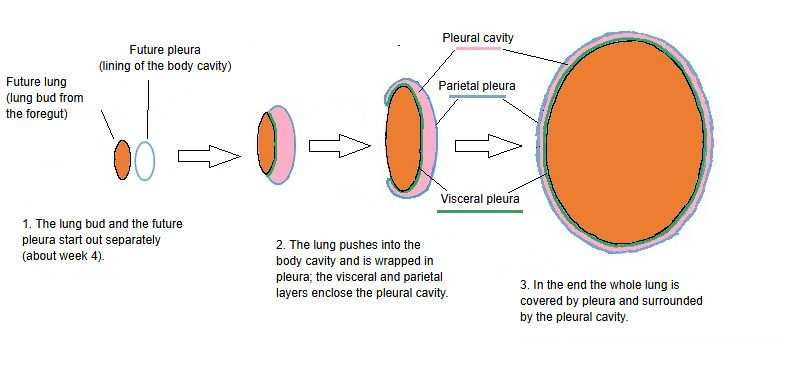
Development: the lung bud grows from the foregut, and the pleura comes from the mesoderm lining the body cavity. As the lung bud grows into the body cavity it pushes into this lining, which wraps it like a fist pushed into a balloon. The layer on the lung becomes the visceral pleura, the outer layer becomes the parietal pleura, and the space between them is the pleural cavity.
· The pleural cavity therefore takes up only a very small part of the thoracic cavity: the slit inside each pleural sac, not the space occupied by the lung.
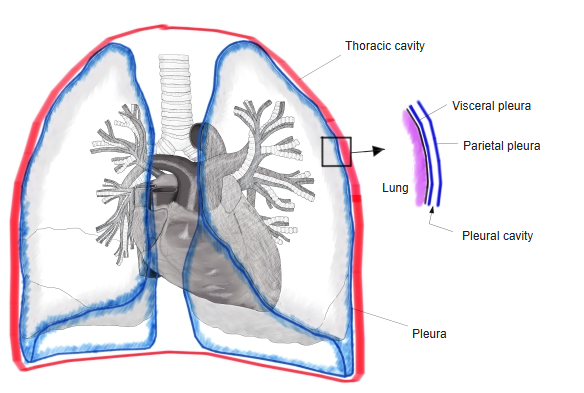
Where it is found
Related terms
- Visceral pleura
- Parietal pleura
- Costodiaphragmatic recess
- Costomediastinal recess
- Mediastinum
- Lung
- Pleura
References and sources
- Further reading: Pleural cavity, Wikipedia.
- Federative International Programme for Anatomical Terminology (FIPAT). Terminologia Anatomica, 2nd ed. (TA2), 2019.