Primary process
Also called the major process or trabecula (of a podocyte)
Overview
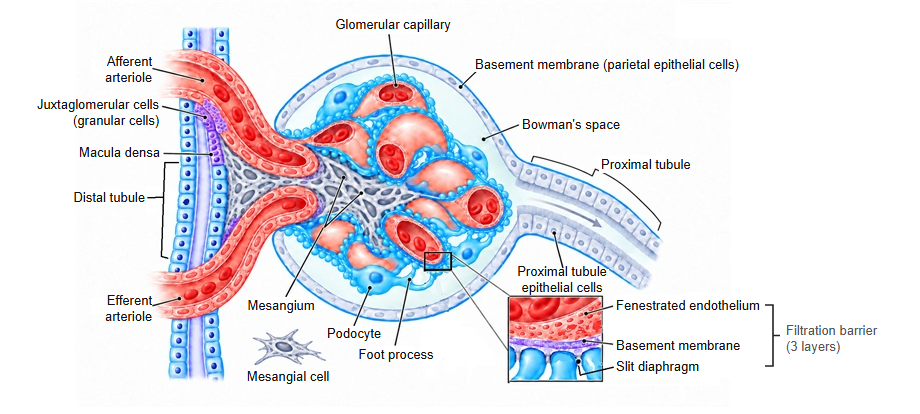
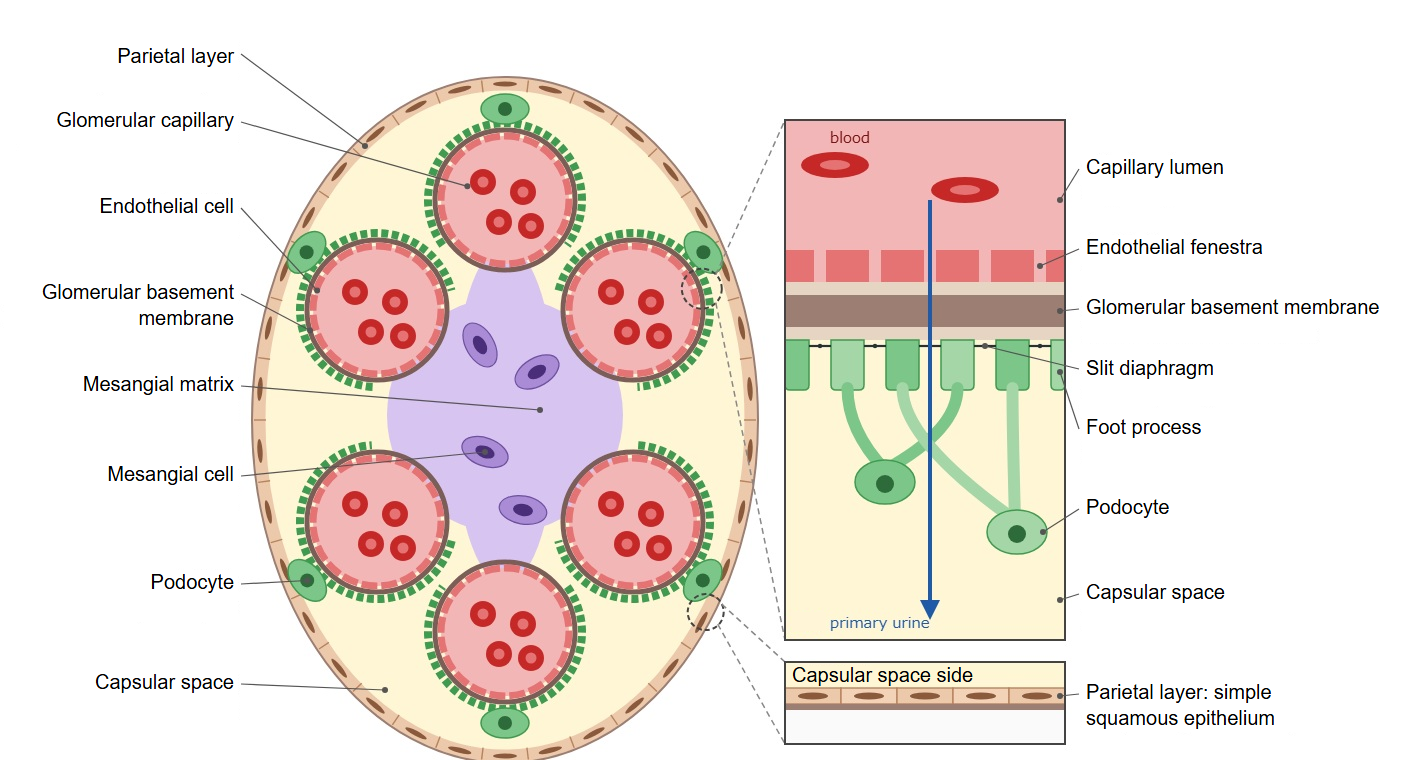
· A primary process is a thick process that leaves the cell body of a podocyte and runs along the surface of a glomerular capillary, giving off many foot processes. It is also called the major process, or in English the trabecula.
· A podocyte branches in the order cell body → primary processes → foot processes. Some sources describe one more order of processes between the primary processes and the foot processes and then call the foot processes tertiary processes.
· Primary processes contain many microtubules and intermediate filaments, which form their framework. Foot processes, by contrast, are built mainly on actin.
· The cell body and primary processes do not attach directly to the glomerular basement membrane; they float in the capsular space (Bowman's space). Only the foot processes attach to the basement membrane. The narrow space between the cell body or primary processes and the basement membrane is called the subpodocyte space.
· The foot processes from a primary process interdigitate with those of neighbouring podocytes, and the gaps between them form the filtration slits.
Reference websites
[Wikipedia]
· Podocyte, Wikipedia.
[Websites with illustrations]
· Structure and cytoskeleton of podocytes (Wikimedia Commons)

· Podocyte morphology (Wikimedia Commons)

· Podocytes (OpenStax) (Wikimedia Commons)

· Glomerulus in scanning electron microscopy (Wikimedia Commons)

Related terms
- Podocyte
- Glomerular capillary
- Glomerular basement membrane
- Capsular space
- Visceral layer of glomerular capsule
- Glomerular capsule
References and sources
- Further reading: Podocyte, Wikipedia.
- Federative International Programme for Anatomical Terminology (FIPAT). Terminologia Anatomica, 2nd ed. (TA2), 2019.