Pyloric valve
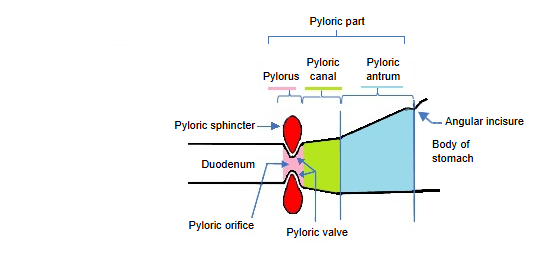
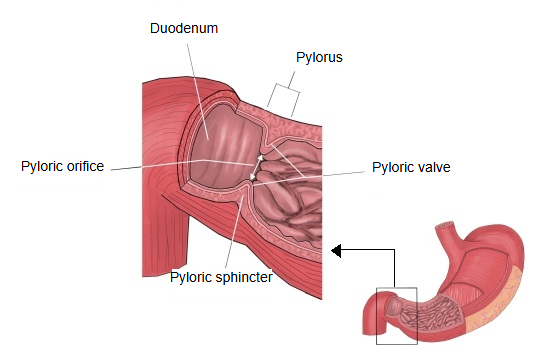
· It is the ring-shaped fold of mucosa raised by the pyloric sphincter around the pyloric orifice, at the junction of the stomach and the duodenum.
· It is not a true valve with cusps: it is the inward bulge of the thickened circular muscle of the pylorus, covered by mucosa.
· "Pyloric valve" is a descriptive name and is not listed in Terminologia Anatomica; the structures behind it are the pyloric sphincter and the pyloric orifice.
What the valve does
1. 1. Passing food on to the small intestine
It controls how the food digested in the stomach (chyme) is passed on into the duodenum, letting small amounts through at a time.
2. 2. Preventing backflow
It limits the backflow of duodenal contents, such as bile, into the stomach.
3. 3. Timing of digestion
When digestion in the stomach is not yet far enough advanced, the valve stays closed and keeps the food in the stomach for further digestion and mixing.
of the
stomach
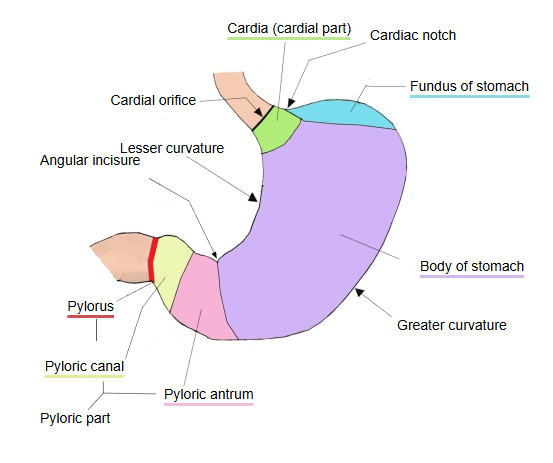
- Cardia : the area round the upper opening, where the oesophagus joins (cardial orifice, cardiac notch).
- Body : the large main part in the middle (with the gastric canal along the lesser curvature).
- Fundus : the part that bulges up and to the left of the body.
- Pyloric part : the area round the lower opening, leading to the duodenum.
- Pylorus : the end of the stomach, at the junction with the duodenum: pyloric valve, pyloric sphincter, pyloric orifice.
- Pyloric canal : the last 2-3 cm of the stomach before the pylorus.
- Pyloric antrum : the wider part before the pyloric canal, bounded above by the angular incisure, where it meets the body.
Reference websites
[Wikipedia]
· Pylorus, Wikipedia.
[Websites with illustrations]
· Stomach (Kenhub)
· The stomach (TeachMeAnatomy)
· Interior of the stomach (Gray's Anatomy) (Wikimedia Commons)

Related terms
References and sources
- Further reading: Pylorus, Wikipedia.
- Federative International Programme for Anatomical Terminology (FIPAT). Terminologia Anatomica, 2nd ed. (TA2), 2019.