Sebum
It forms as follows.
The gland cells of the sebaceous gland make the secretion inside themselves and store large amounts of it; then the whole cell breaks down and is released into the lumen of the gland (holocrine secretion, one form of exocrine secretion).
Sebum is therefore made of the whole broken-down sebaceous gland cells.
Sebum and acne:
At puberty the secretion of sebum increases under the influence of sex hormones (mainly androgens). If more keratin builds up on the inner surface of the pore and the sebum cannot leave the pore quickly,
it collects in the pore together with the keratin
and can cause acne.
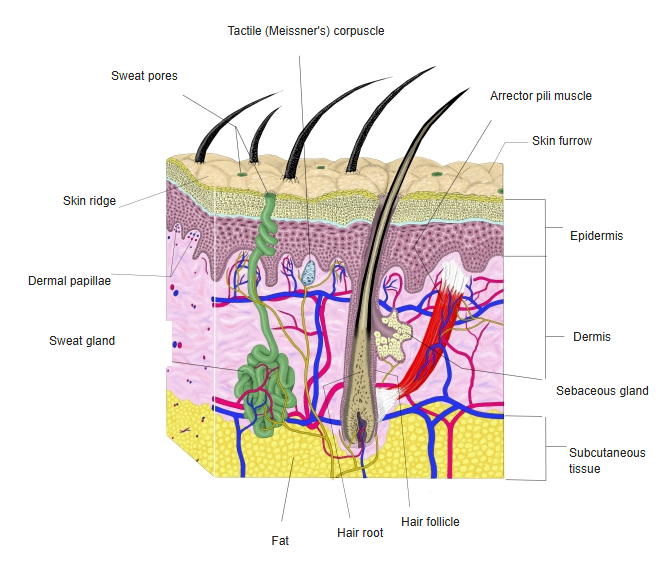
Composition
What secreted sebum contains
Fatty acids, wax esters, sterol esters, cholesterol, cholesterol esters and squalene.
Bacteria living on the skin break part of it down into diglycerides, monoglycerides and free fatty acids.
Among the fatty acids, unsaturated fatty acids (such as oleic, linoleic, palmitoleic and sapienic acid) are more abundant than saturated ones (such as palmitic and stearic acid). Sapienic acid is found only in human sebum.
One study reported the following changes in the composition of sebum (figures differ between sources).
| Changes in sebum | |||
| Secreted sebum | After exposure to Malassezia | After antifungal treatment | |
| Triglycerides | 35% or less | 18% | 32% |
| Free fatty acids | 13% or more | 32% | 16% |
| Wax esters | 25% | 23% | 25% |
| Squalene | 15% | same | same |
| Cholesterol and cholesterol esters | 7% | same | same |
| Others | less than 5% | same | same |
Malassezia is a yeast that lives on the skin; its lipases split triglycerides into free fatty acids. English Wikipedia gives a different average composition: triglycerides about 41%, wax esters 26%, squalene 12% and free fatty acids 16%.
Related terms
- Secretion
- Exocrine secretion
- Sebaceous glands
- Skin glands
- Hair follicle
- Neck of hair follicle
- Skin
- Epidermis
- Hair
References and sources
- Further reading: Sebaceous gland, Wikipedia.
- Federative International Programme for Anatomical Terminology (FIPAT). Terminologia Anatomica, 2nd ed. (TA2), 2019.