Sternocostal triangle (Latin: trigonum sternocostale)
Also called the sternocostal hiatus or Larrey's cleft or the foramen of Morgagni
Also called Larrey's cleft or the sternocostal hiatus.
Other names: Larrey's triangle; foramen of Morgagni. Sources differ on the eponyms: some call both gaps the foramina of Morgagni, others use Morgagni for the right gap and Larrey for the left.
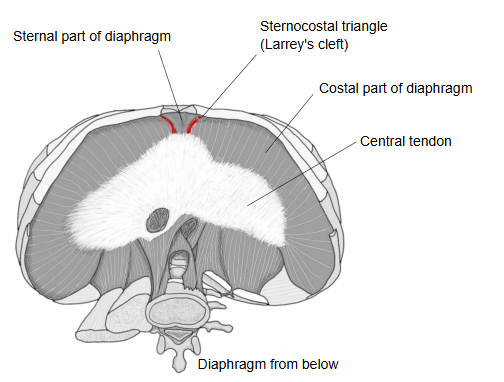
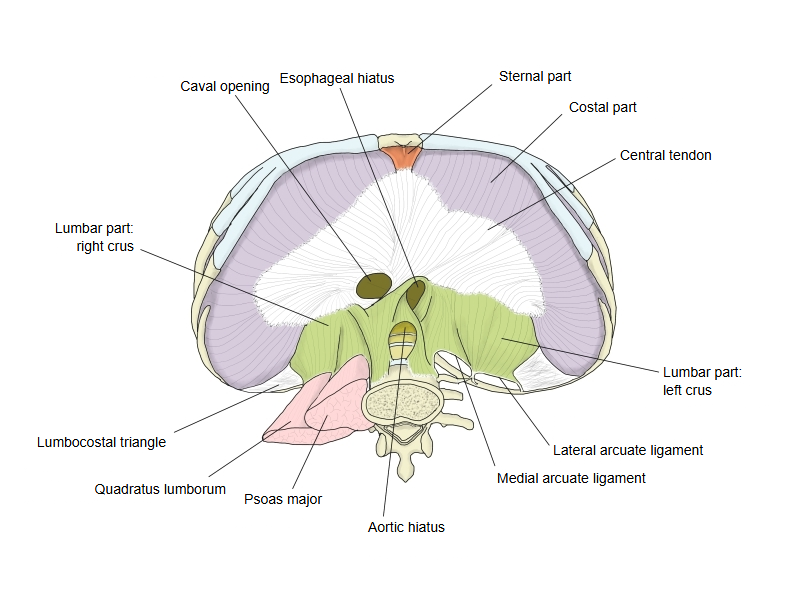
There is one on each side, just behind the lower end of the sternum and the seventh costal cartilage. The superior epigastric artery, the terminal branch of the internal thoracic artery, passes through it from the thorax into the rectus sheath. Like the lumbocostal triangle at the back, it is a weak spot in the diaphragm: abdominal contents can herniate through it into the thorax (anterior diaphragmatic hernia, or Morgagni hernia). The other parts of the diaphragm include the central tendon and the domes.
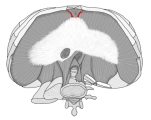 Sternocostal triangle (diaphragm from below)
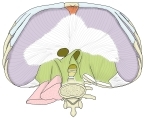 Parts and openings of the diaphragm
Reference websites
[Wikipedia]
· Sternocostal triangle, Wikipedia.
[Websites with illustrations]
· Weak areas of the diaphragm: sternocostal and lumbocostal triangles (Blogger)

· The diaphragm, under surface (Gray's Anatomy, fig. 391) (Wikimedia Commons)

Related terms
- Diaphragm
- Central tendon of diaphragm
- Dome of diaphragm
- Superior epigastric artery
- Internal thoracic artery
- Superior epigastric veins
References and sources
- Further reading: Sternocostal triangle, Wikipedia.
- Federative International Programme for Anatomical Terminology (FIPAT). Terminologia Anatomica, 2nd ed. (TA2), 2019.