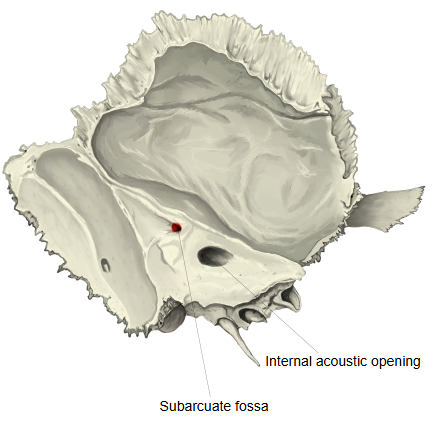
Subarcuate fossa (Latin: fossa subarcuata)
· It is especially large in children: in the infant it extends backwards as a blind tunnel under the anterior (superior) semicircular canal, and it becomes small in the adult.
· A small vein and the subarcuate artery pass through it.
· It lies beneath the arcuate eminence, under the anterior semicircular canal (one of the semicircular canals). In many other mammals it is large and holds part of the cerebellum (the petrosal lobule).
Reference websites
[Wikipedia]
· Subarcuate fossa, Wikipedia.
· Petrous part of the temporal bone, Wikipedia.
[Websites with illustrations]
· Left temporal bone, inner surface (Gray's Anatomy, fig. 138) (Wikimedia Commons)

· Base of the skull, inner surface (Gray's Anatomy, fig. 193) (Wikimedia Commons)

Related terms
- Petrous part
- Internal acoustic meatus
- Temporal bone
- Semicircular canals
- Area of facial nerve
- Labyrinthine artery
References and sources
- Further reading: Subarcuate fossa, Wikipedia.
- Further reading: Petrous part of the temporal bone, Wikipedia.
- Federative International Programme for Anatomical Terminology (FIPAT). Terminologia Anatomica, 2nd ed. (TA2), 2019.