Torus levatorius (Latin: torus levatorius)
Also called Levator swelling or the levator cushion
· It forms the floor of the pharyngeal opening of the auditory tube and runs down and forward from it towards the soft palate.
· The ridge becomes more prominent when the muscle contracts, as in swallowing and speaking, when levator veli palatini raises the soft palate.
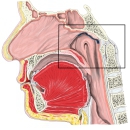 Nasopharynx (lateral wall)
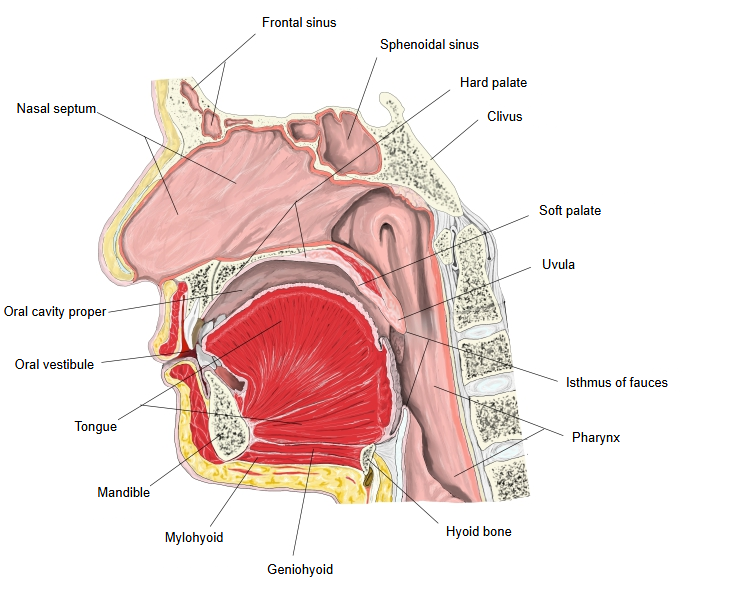
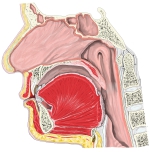 Nose, mouth and pharynx (median section)
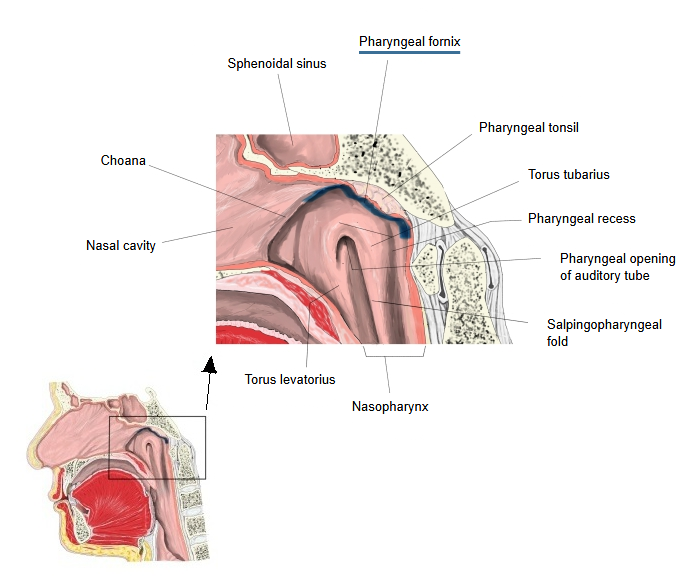
The pharyngeal opening of the auditory tube is bounded by two lips, of which the posterior one is the higher. The prominent rim above and behind the opening, formed chiefly by the posterior lip over the end of the tubal cartilage, is the torus tubarius (some older texts count both lips together as the torus). In the floor of the opening the mucosa is raised by the levator veli palatini: this is the torus levatorius. From the torus tubarius a mucosal fold, the salpingopharyngeal fold, runs downwards but soon fades out. Behind the torus tubarius the mucosa sinks into a blind pocket, the pharyngeal recess (fossa of Rosenmüller), whose shape varies a great deal; its wall is formed by lateral extensions of the pharyngeal tonsil.
Reference websites
[Wikipedia]
· Levator veli palatini, Wikipedia.
· Pharynx, Wikipedia.
[Websites with illustrations]
· The pharynx (TeachMeAnatomy)
· Nasopharynx (Radiopaedia)
Where it is found
Related terms
- Pharyngeal opening of auditory tube
- Pharyngeal recess
- Nasopharynx
- Soft palate
- Levator veli palatini
- Auditory tube
References and sources
- Further reading: Levator veli palatini, Wikipedia.
- Further reading: Pharynx, Wikipedia.
- Federative International Programme for Anatomical Terminology (FIPAT). Terminologia Anatomica, 2nd ed. (TA2), 2019.