Tubercle (Latin: tuberculum)
A tubercle is a small, rounded projection on a bone.
It usually gives attachment to a muscle or ligament
A tubercle is smaller than a tuberosity and is in effect a small tuber, but the names are set by custom and not by measurement. Unlike a condyle, it does not normally form a joint, and unlike an epicondyle, it need not lie near a condyle.
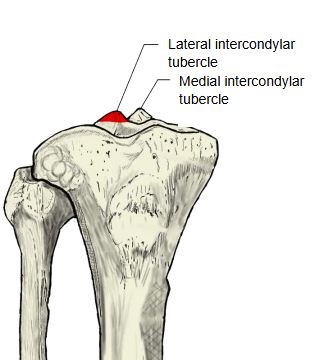
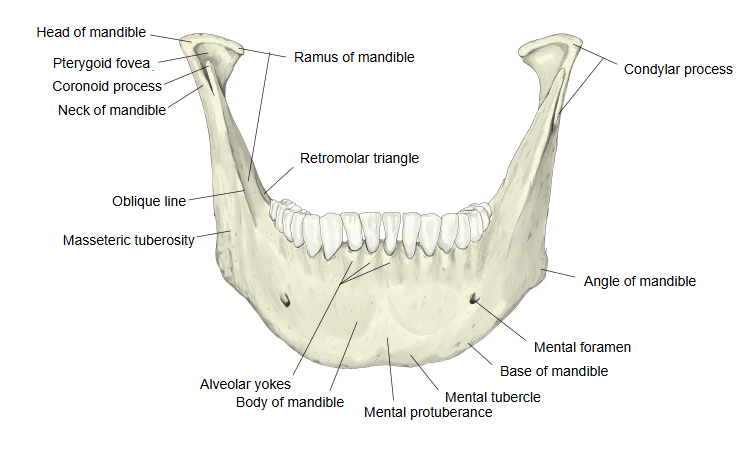
Examples are the greater and lesser tubercles of the humerus, which receive muscles of the shoulder; the lateral and medial intercondylar tubercles of the tibia; the mental tubercle of the mandible; and the adductor tubercle of the femur. The word is not limited to bone: the auricular tubercle is on the cartilage of the ear.
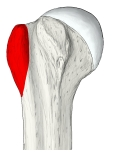 Greater tubercle of humerus
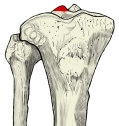 Lateral intercondylar tubercle of tibia
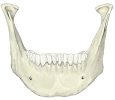 Mental tubercle of mandible
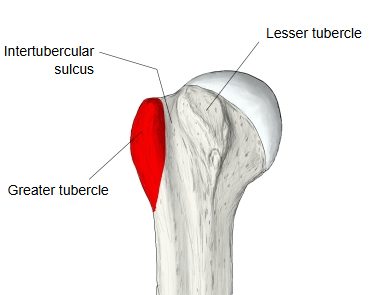
Related terms
- Tuberosity
- Tuber
- Condyle
- Epicondyle
- Greater tubercle
- Lesser tubercle
- Lateral intercondylar tubercle
- Medial intercondylar tubercle
- Mental tubercle
- Adductor tubercle
References and sources
- Further reading: Anatomical terms of bone, Wikipedia.
- Federative International Programme for Anatomical Terminology (FIPAT). Terminologia Anatomica, 2nd ed. (TA2), 2019.