Tuberculum sellae (Latin: tuberculum sellae)
Also called the tubercle of the sella turcica
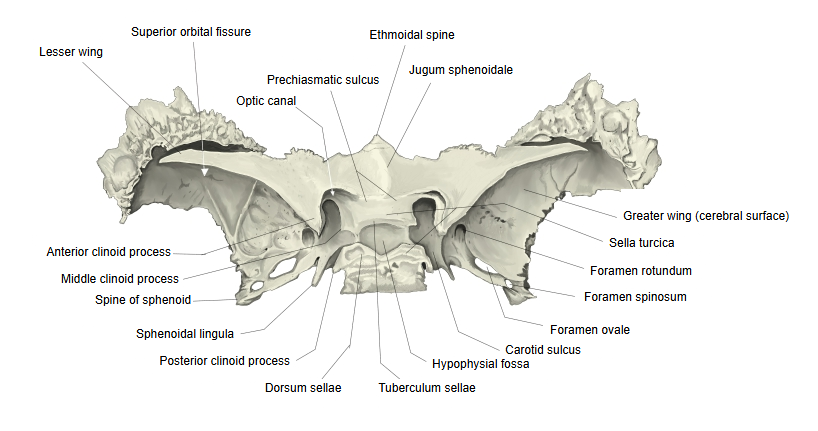
· Just in front of the hypophysial fossa = just behind the chiasmatic groove (sulcus chiasmaticus).
Its two ends may project as the middle clinoid processes, which are often absent.
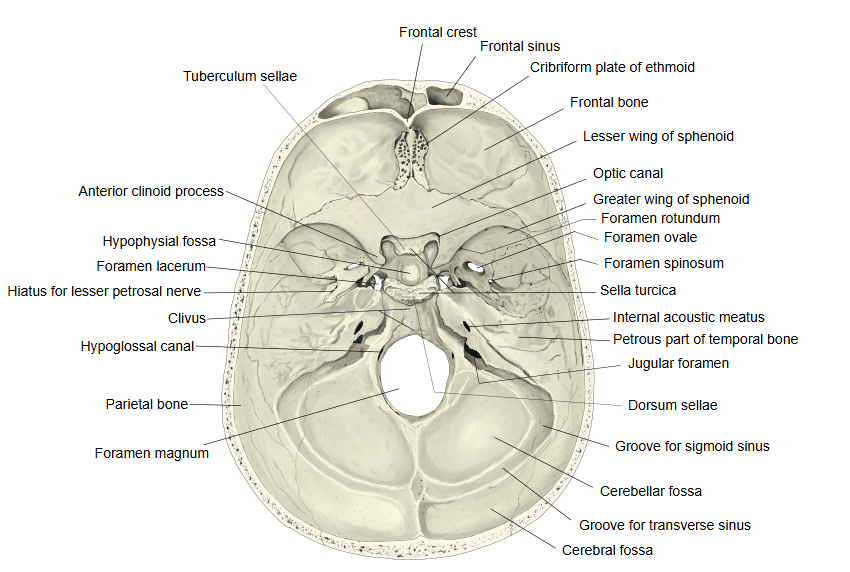
It lies in the midline and forms the front boundary of the hypophysial fossa; with the fossa and the dorsum sellae it makes up the sella turcica, which holds the pituitary gland. The chiasmatic groove in front of it leads at each end into the optic canal; behind the sella the bone slopes down as the clivus.
Its height varies from a slight rise to a clear ridge.
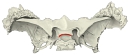 Sphenoid bone (superior view)
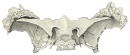 Sphenoid bone (superior view, labelled)
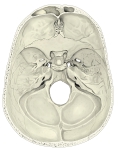 Cranial fossae (internal surface of the cranial base)
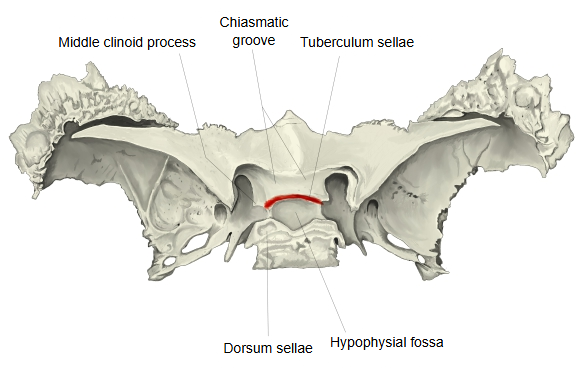
Reference websites
[Wikipedia]
· Tuberculum sellae, Wikipedia.
[Websites with illustrations]
· Middle cranial fossa: boundaries and contents (TeachMeAnatomy)
· Sphenoid bone: anatomy, function and development (Kenhub)
· Sphenoid bone, upper surface (Gray's Anatomy, fig. 145) (Wikimedia Commons)

Related terms
References and sources
- Further reading: Tuberculum sellae, Wikipedia.
- Federative International Programme for Anatomical Terminology (FIPAT). Terminologia Anatomica, 2nd ed. (TA2), 2019.