Tuberosity for serratus anterior (Latin: tuberositas musculi serrati anterioris)
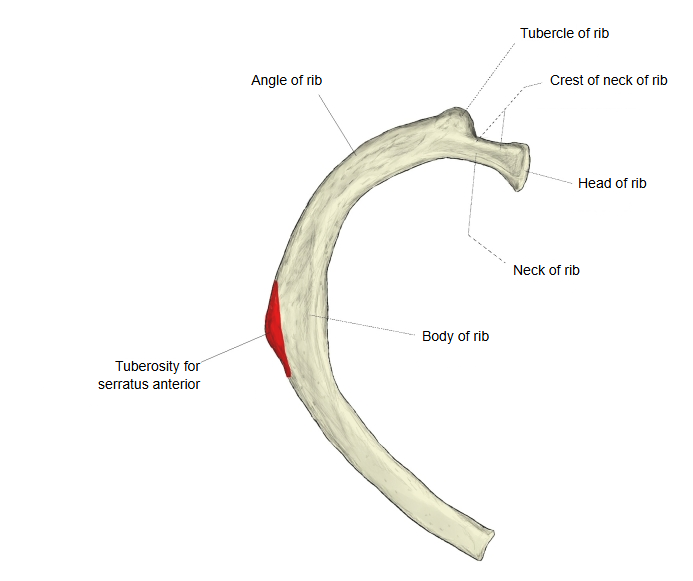
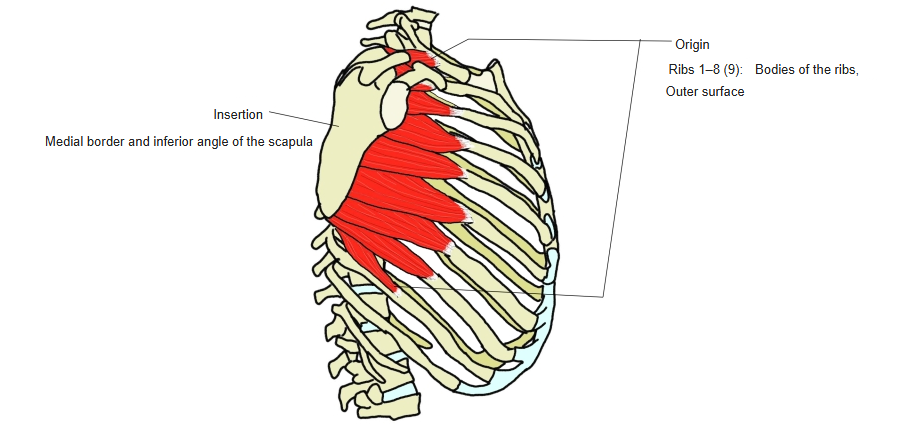
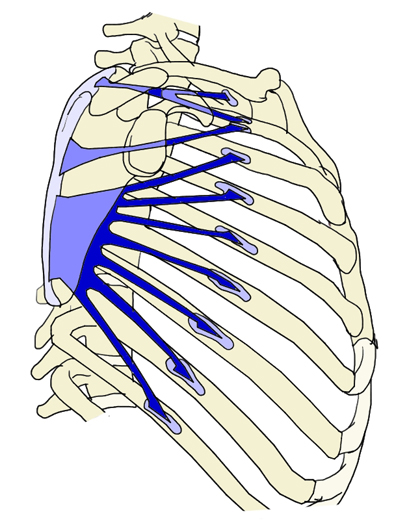
It lies on the outer (upper and lateral) surface of the body of the second rib, roughly halfway between the angle of rib and the front end. It gives origin to the lower part of the first digitation and the whole of the second digitation of the serratus anterior; the muscle arises from the outer surfaces of the upper eight or nine ribs and inserts on the medial border and inferior angle of the scapula. Just behind and above the tuberosity the second rib gives attachment to the posterior scalene. The tuberosity is one of the features that help to identify an isolated second rib.
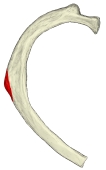 Right 2nd rib (superior view)
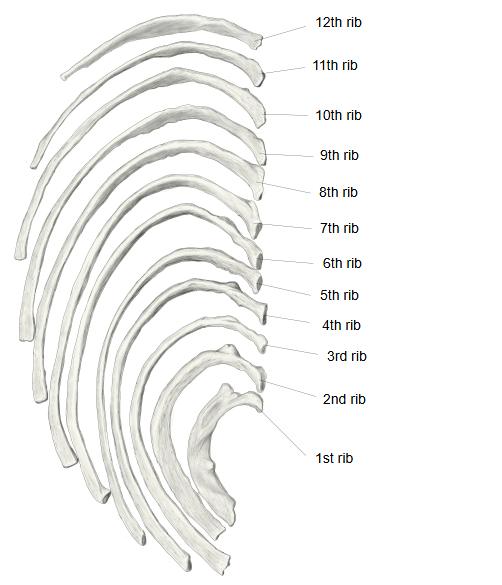
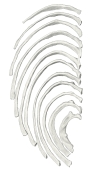 Right ribs 1–12 (superior view)
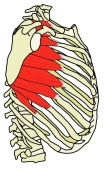 Right serratus anterior
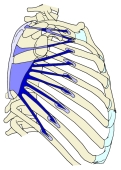 Right serratus anterior (scheme)
Reference websites
[Wikipedia]
· Serratus anterior muscle, Wikipedia.
· Rib cage, Wikipedia.
[Websites with illustrations]
· Second rib (Gray's Anatomy, fig. 125) (Wikimedia Commons)

· Ribs: anatomy, ligaments and clinical notes (Kenhub)
· The ribs (typical and atypical ribs) (TeachMeAnatomy)
Related terms
- Scalene tubercle
- Ribs
- Serratus anterior
- Body of rib
- Angle of rib
- Head of rib
- Posterior scalene
- Scapula
References and sources
- Further reading: Serratus anterior muscle, Wikipedia.
- Federative International Programme for Anatomical Terminology (FIPAT). Terminologia Anatomica, 2nd ed. (TA2), 2019.