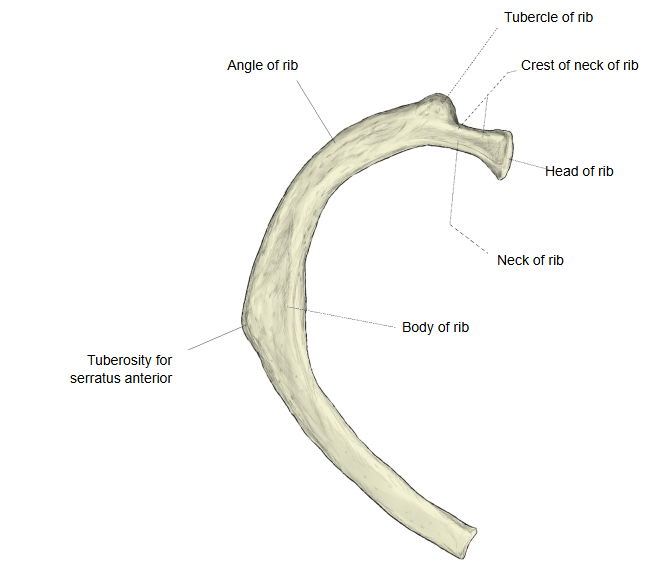
Angle of rib (Latin: angulus costae)
Seen from behind and above, the costal bone (the bony part of the rib) changes the direction of its curve abruptly a few centimetres lateral to the tubercle. Here the body bends forwards, and the back surface of the rib forms a rough, more or less angled ridge: the angle of rib.
Because of this bend, the neck and head of the rib, medial to the angle, are directed medially and slightly upwards towards the vertebral column.
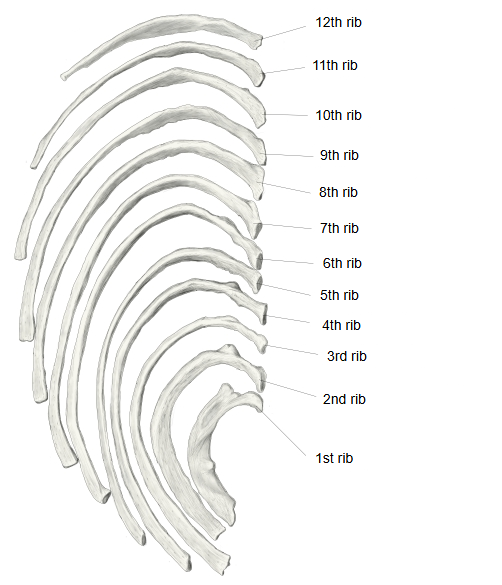
The distance between the tubercle and the angle increases from the upper to the lower ribs. On the 1st rib the angle coincides with the tubercle; the 12th rib has no clear angle. The iliocostalis part of the erector spinae attaches to the angles, and behind, the internal intercostal muscles end near them and are continued medially by the internal intercostal membrane.
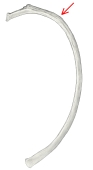 Left 5th rib (superior view)
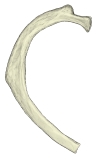 Right 2nd rib (superior view)
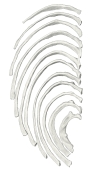 Right ribs 1–12 (superior view)
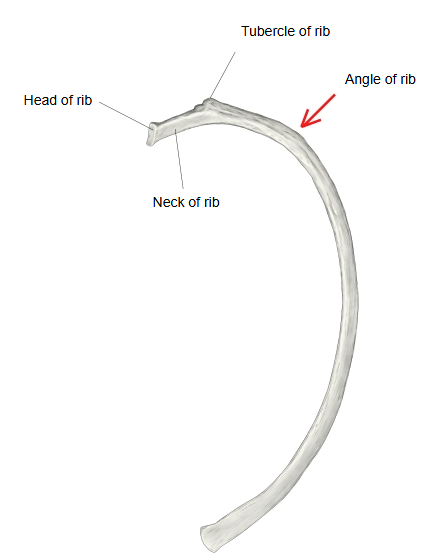
Video
Video on the ribs (typical and atypical ribs, true and false ribs):
Related terms
- Costal bone
- Body of rib
- Neck of rib
- Crest of neck of rib
- Crest of head of rib
- Crest of body of rib
- Articular facet of head of rib
- Tubercle of rib
- Head of rib
- Costal groove
- Costal cartilage
- Internal intercostal membrane
- Ribs
References and sources
- Further reading: Rib, Wikipedia.
- Federative International Programme for Anatomical Terminology (FIPAT). Terminologia Anatomica, 2nd ed. (TA2), 2019.