Vomerovaginal groove (Latin: sulcus vomerovaginalis)
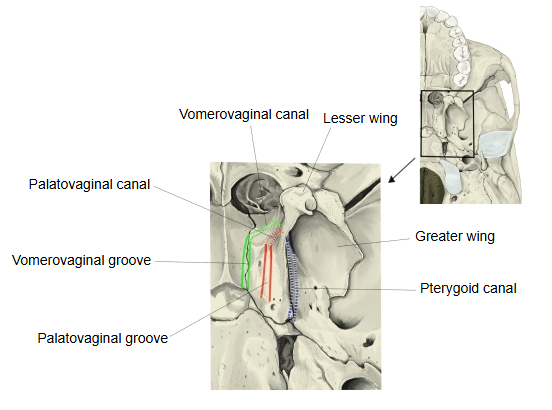
The exact position of the groove in the figure is approximate.
The vomerovaginal groove lies between the medial edge of the vaginal process and the body of the sphenoid. Where the ala of the vomer meets the sphenoid bone, it becomes the vomerovaginal canal. The small passages of the palatovaginal canal and the vomerovaginal canal both carry pharyngeal branches from the pterygopalatine ganglion.
A question about its contents
Whether it is a canal or a groove, the passage is continuous, so the same structures should pass through it. One anatomy reference, however, gives different contents for the vomerovaginal canal and the vomerovaginal groove:
· Vomerovaginal canal: a passage for a branch of the sphenopalatine artery. Is this a mistake, or do both an artery and a nerve pass through?
· Vomerovaginal groove: the pharyngeal branch of the pterygopalatine ganglion.
English references usually name the pharyngeal branch from the pterygopalatine ganglion, and some add a small artery (a branch of the sphenopalatine artery, or a pharyngeal branch of the maxillary artery) running to the roof of the nasopharynx. So sources differ, and both an artery and a nerve twig may run in the same passage.
Reference websites
[Wikipedia]
· Vomer, Wikipedia.
· Sphenoid bone, Wikipedia.
[Websites with illustrations]
· Vomerovaginal and palatovaginal canals on a dry skull (inferior view) (Journal of Anatomy)

· Vaginal process, vomerovaginal and palatovaginal canals (diagram) (Jaypee Digital)

Related terms
- Vomerovaginal canal
- Vaginal process
- Palatovaginal groove
- Palatovaginal canal
- Ala of vomer
- Body of sphenoid
- Pterygoid process
References and sources
- Further reading: Vomer, Wikipedia.
- Further reading: Sphenoid bone, Wikipedia.
- Federative International Programme for Anatomical Terminology (FIPAT). Terminologia Anatomica, 2nd ed. (TA2), 2019.