Carpometacarpal joints (Latin: articulationes carpometacarpales)
- What are the carpometacarpal joints?
- Carpometacarpal joints of the 2nd–5th metacarpals
- Carpometacarpal joint of the 1st metacarpal (thumb)
What are the carpometacarpal joints?
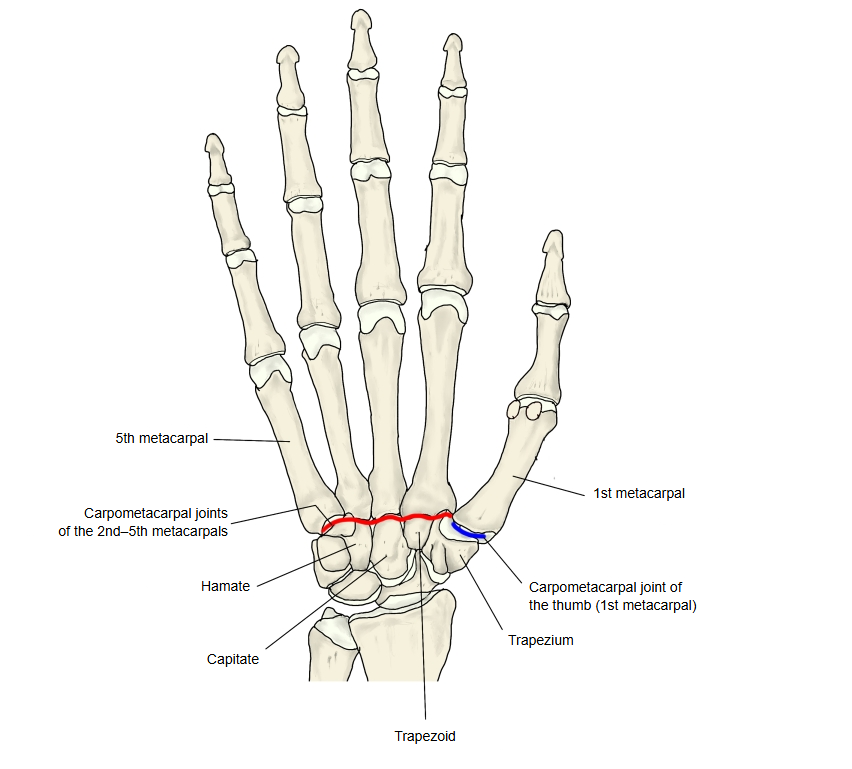
The joints between the distal carpal bones and the bases of the metacarpal bones. They are usually divided into the following two groups.
- Carpometacarpal joints of the 2nd–5th metacarpals
- Carpometacarpal joint of the 1st metacarpal (thumb)
Carpometacarpal joints of the 2nd–5th metacarpals
The joints between the bases of the 2nd to 5th metacarpal bones and the distal carpal bones.
Bones
Type
Descriptions differ. They are described as modified saddle joints that move so little that they behave almost like an amphiarthrosis, or as joints close to plane joints. Either way, the 2nd and 3rd carpometacarpal joints hardly move, while the 4th and especially the 5th allow a little more movement.
Ligaments
The ligaments related to these joints are listed below; the list may not be complete.
Carpometacarpal joint of the 1st metacarpal (thumb)
The joint between the base of the 1st (thumb) metacarpal bone and the trapezium.
It is a typical saddle joint. The articular surface of the trapezium is convex from the palm to the back and concave from side to side; the surface of the 1st metacarpal has the opposite curves. Its joint capsule is separate from that of the other carpometacarpal joints and is wide and loose, so the thumb moves much more freely than the other metacarpals. The capsule is stronger on the dorsal side than on the palmar side; a fan-shaped band of fibres from the outer back of the trapezium to the 1st metacarpal slightly limits opposition of the thumb.
The joint moves about two axes at right angles to each other: flexion and extension, and adduction (bringing the thumb towards the index finger) and abduction (moving it away). Combining these with a little rotation gives circumduction, and this rotation is what makes opposition of the thumb possible.
Bones
Type
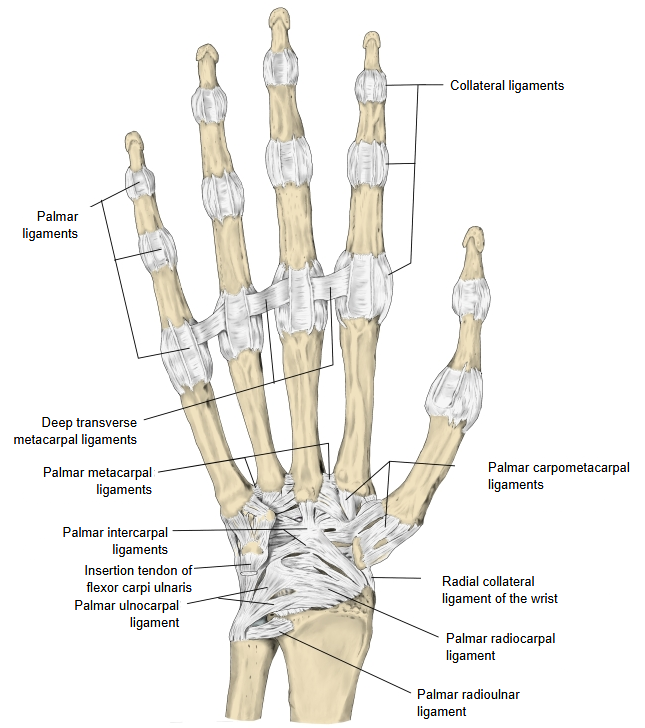
Ligaments
Sources do not agree on which named ligaments belong to the carpometacarpal joint of the thumb. Some illustrations show the dorsal carpometacarpal ligaments reaching the 1st metacarpal and others do not. The palmar carpometacarpal ligaments are usually described as joining the carpal bones to the 2nd to 5th metacarpals only. The joint is held mainly by its own thickened capsule.