Distal carpal row (Latin: ossa carpi distalia)
Also called the distal row of carpal bones or the distal carpal bones
The four carpal bones that lie in the distal row (the row nearer the fingers). The four carpal bones of the proximal row are called the proximal carpal row.
- Distal carpal bones : the 4 carpal bones in the distal row.
- Proximal carpal bones : the 4 carpal bones in the proximal row.
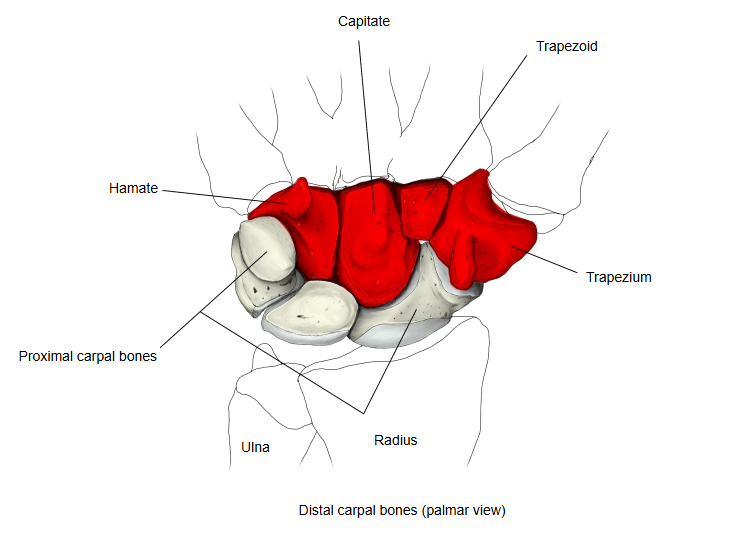
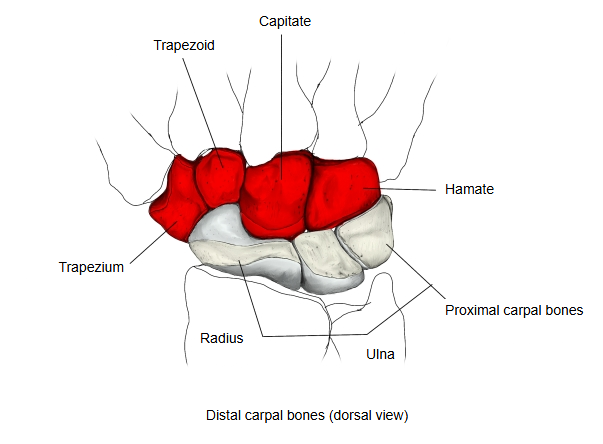
They are the following four bones.
· From lateral (thumb side) to medial they are the trapezium, trapezoid, capitate and hamate.
· Distally they meet the bases of the five metacarpals at the carpometacarpal joints; proximally they meet the proximal row at the midcarpal joint.
· They are bound tightly to one another and to the metacarpals, so the distal row moves with the hand as one unit.
· On the palmar side, the tubercle of the trapezium and the hook of the hamate form the lateral and medial walls of the carpal tunnel.
· The capitate is the largest carpal bone; the trapezium carries the saddle-shaped joint for the metacarpal of the thumb.
 Carpal bones
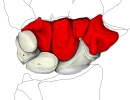 Distal carpal bones (palmar view)
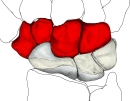 Distal carpal bones (dorsal view)
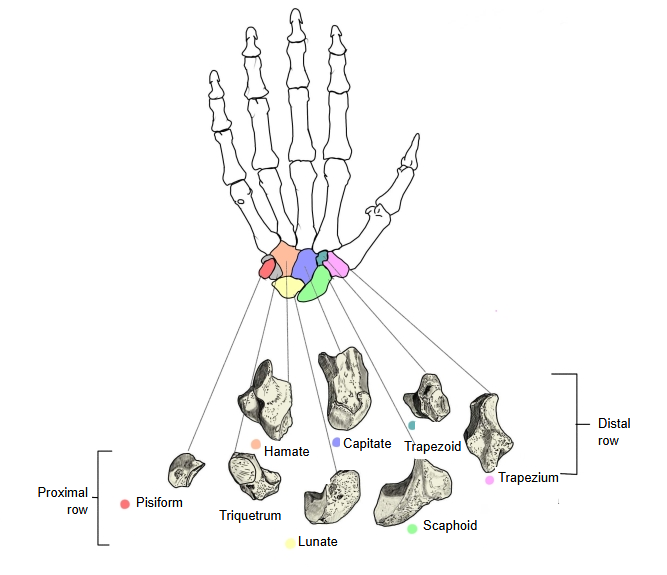
Where it is found
Related terms
- Carpal bones
- Proximal carpal row
- Midcarpal joint
- Carpometacarpal joint
- Intercarpal joints
- Tubercle of trapezium
- Carpal tunnel
References and sources
- Further reading: Carpal bones, Wikipedia.
- Further reading: Wrist, Wikipedia.
- Federative International Programme for Anatomical Terminology (FIPAT). Terminologia Anatomica, 2nd ed. (TA2), 2019.