Humeroradial joint (Latin: articulatio humeroradialis)
What is the humeroradial joint?
- Bones: capitulum of the humerus (humerus) ⇔ articular fovea of the head of the radius (radius)
- Movement: it only follows the movements of the radius.
- Humeroulnar joint : a hinge joint between the trochlea of the humerus and the trochlear notch of the ulna
- Humeroradial joint : a ball-and-socket joint between the capitulum of the humerus and the articular fovea of the head of the radius
- Superior radioulnar joint : a pivot joint between the radial notch of the ulna and the articular circumference of the radius
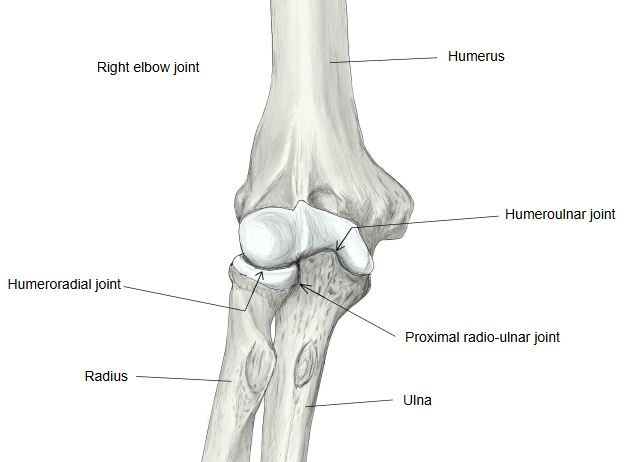
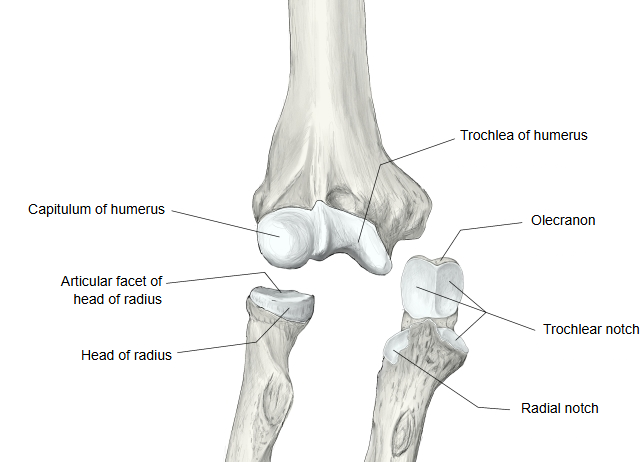
The humeroradial joint is the radial part of the elbow joint, between the capitulum of the humerus and the shallow socket on the upper surface of the head of the radius. It takes part in flexion and extension of the elbow. Working together with the other two joints of the elbow, the humeroulnar and superior radioulnar joints, it lets the radius turn around the ulna (pronation and supination) in any position of flexion or extension.
By the shape of its surfaces it is a ball-and-socket joint and could move in all directions, but the Annular ligament of radius binds the head of the radius to the radial notch of the ulna and stops the two bones from separating sideways, so its movements are limited. The ligament also keeps the head of the radius in place: the cup on the head is shallow, and without the ligament the pull of the tendon of the Biceps brachii could draw it out of the joint.
The head of the radius is not in full contact with the capitulum in every position. The capitulum covers only the front and lower surfaces of the lower end of the humerus, so in full extension part of the head of the radius can be felt at the back of the joint. In full flexion the soft tissues around the joint hinder the head of the radius, so pronation and supination are freest with the elbow half bent, the position in which the two joint surfaces fit most closely. Flexion and extension of the elbow are limited by the tension of the structures in front of and behind the joint; flexion is also limited when the soft parts of the arm and forearm meet.