Humeroulnar joint (Latin: articulatio humeroulnaris)
What is the humeroulnar joint?
- Bones: trochlea of the humerus (humerus) ⇔ trochlear notch (ulna)
- Movement: flexion and extension.
- Humeroulnar joint : a hinge joint between the trochlea of the humerus and the trochlear notch of the ulna
- Humeroradial joint : a ball-and-socket joint between the capitulum of the humerus and the articular fovea of the head of the radius
- Superior radioulnar joint : a pivot joint between the radial notch of the ulna and the articular circumference of the radius
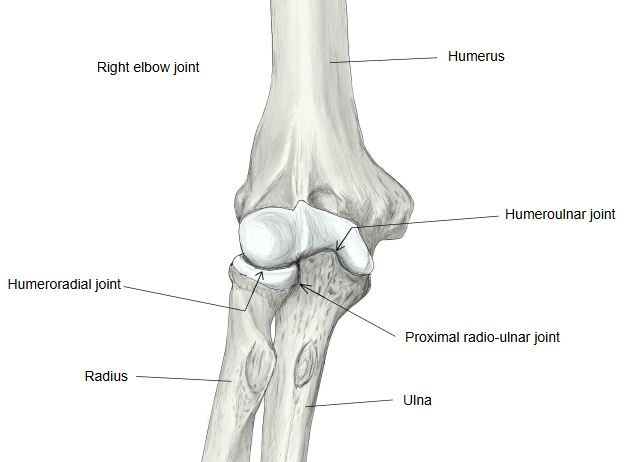
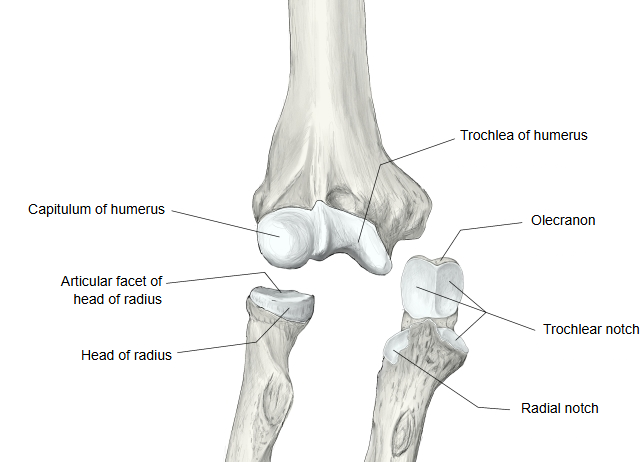
The humeroulnar joint (also called the ulnohumeral or trochlear joint) is the main part of the elbow joint. It is a simple hinge joint: it allows flexion and extension of the forearm. The close fit of the ridges and grooves of the trochlea into the trochlear notch prevents any sideways movement.
Because the trochlea is set obliquely, flexion and extension do not take place exactly in the front-to-back plane of the shaft of the humerus. With the forearm extended and supinated, the arm and forearm are not in line: they meet at an obtuse angle that opens laterally, the carrying angle. In flexion the forearm and hand move towards the midline of the body, which makes it easy to bring the hand to the face.
Flexion is produced by the Biceps brachii and the Brachialis, helped by the Brachioradialis and, a little, by the muscles that arise from the medial epicondyle of the humerus. Extension is produced by the Triceps brachii and the Anconeus, helped a little by the muscles that arise from the lateral epicondyle, such as the Extensor digitorum.