Latin: plexus brachialis
Overview
- Formed by the ventral rami of C5–C8 and T1, often with small contributions from C4 and T2.
- Passes between scalenus anterior and scalenus medius above the first rib (the scalene gap), then runs behind the clavicle down and out to the axilla.
- Its branches supply the shoulder girdle and the whole upper limb.
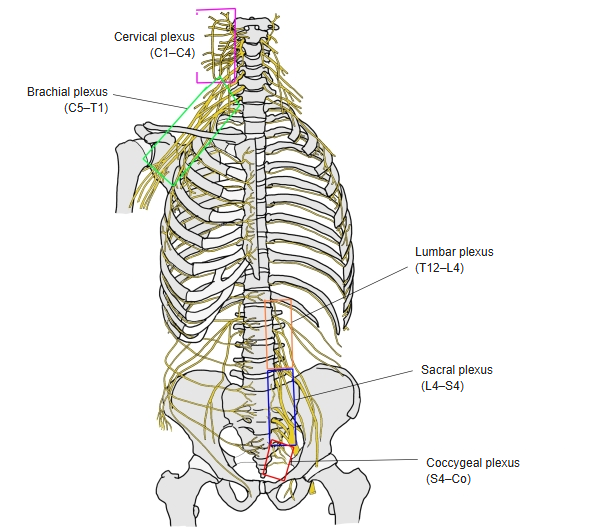
Plexuses of the spinal nerves 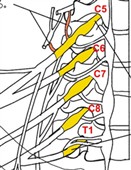
Roots of the brachial plexus
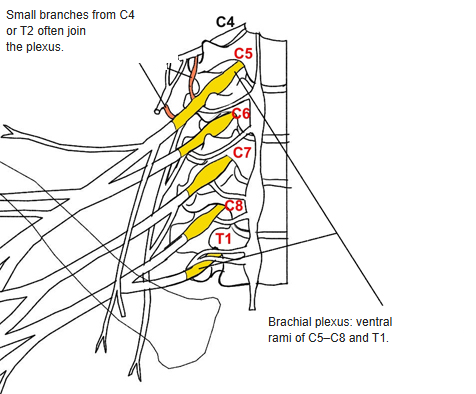
Roots, trunks, divisions and cords
- The pattern is very variable; the usual form is described here.
- Trunks: superior (C5–C6), middle (C7), inferior (C8–T1).
- Each trunk splits into an anterior and a posterior division.
- Cords (named after their position around the axillary artery):
- Posterior cord: the three posterior divisions; continues as the radial nerve.
- Lateral cord: the anterior divisions of the superior and middle trunks.
- Medial cord: the anterior division of the inferior trunk.
- One branch of the lateral cord and one of the medial cord join to form the median nerve; the rest of the lateral cord becomes the musculocutaneous nerve, and the rest of the medial cord the ulnar nerve and the medial cutaneous nerves of the arm and forearm.
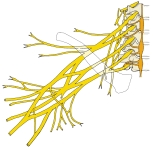
Brachial plexus (schematic) 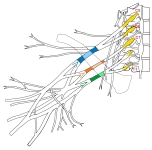
Trunks of the brachial plexus
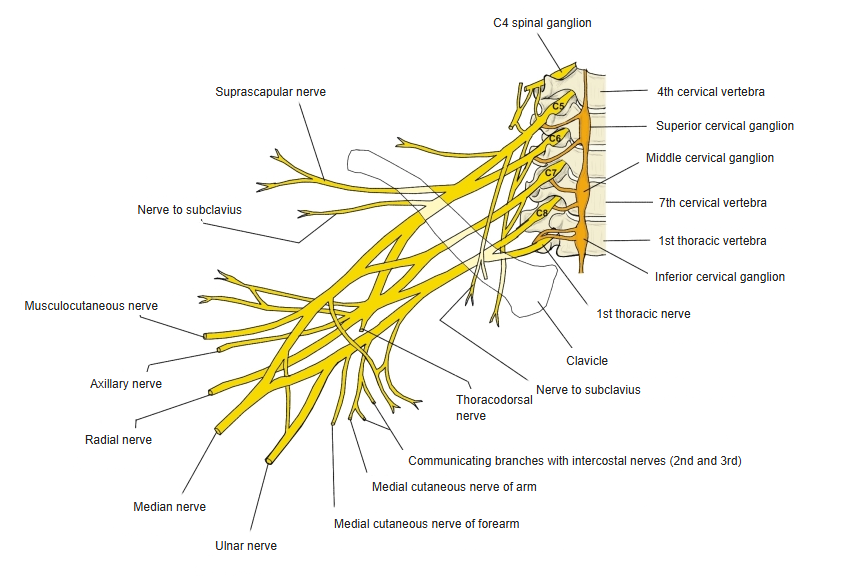
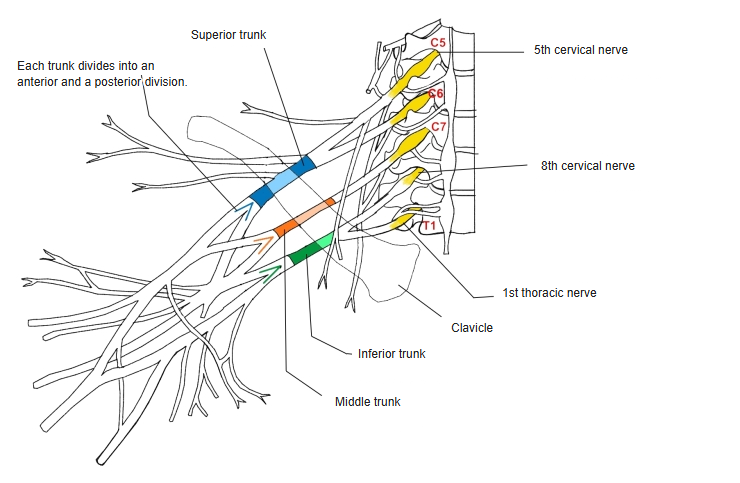
Supraclavicular and infraclavicular parts
- The clavicle divides the plexus into a supraclavicular part (mostly trunks) and an infraclavicular part (cords).
| Part | Branches |
|---|---|
| Supraclavicular | Dorsal scapular, long thoracic, nerve to subclavius, suprascapular nerves |
| Infraclavicular | Lateral and medial pectoral, subscapular, thoracodorsal, axillary, radial, musculocutaneous, median, ulnar, medial cutaneous nerve of arm, medial cutaneous nerve of forearm |
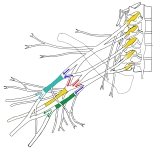
Cords of the brachial plexus
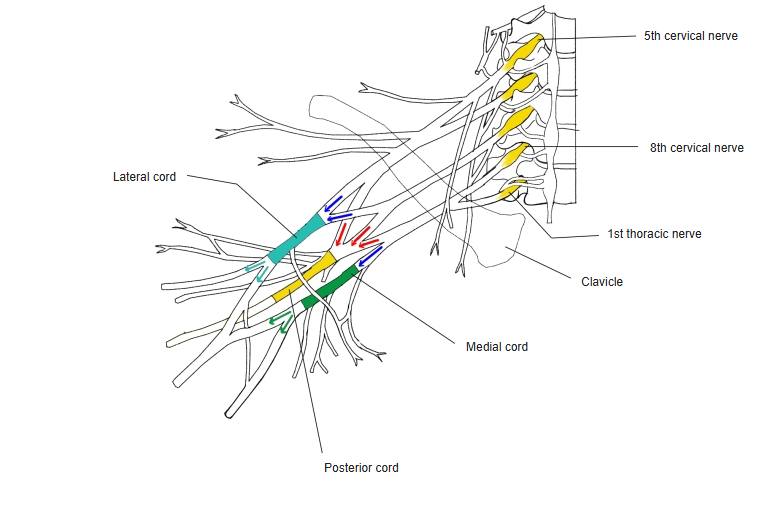
References and sources
- Further reading: Brachial plexus, Wikipedia.